Turkey and the United States are working on plans to provide air cover for Syrian rebels and jointly sweep Islamic State fighters from a strip of land along the Turkish border, bolstering the NATO member's security and possibly providing a safe haven for civilians.
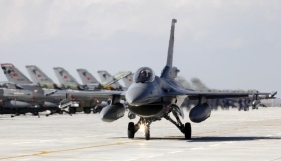
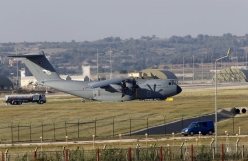
Long a reluctant member of the US-led coalition against Islamic State, Turkey last week made a dramatic turnaround by granting the alliance access to its air bases and bombarding targets in Syria linked to the jihadist movement.
Struggling with more than 1.8 million Syrian refugees, Turkey has long campaigned for a "no-fly zone" in northern Syria to keep Islamic State and Kurdish militants from its border and help stem the tide of displaced civilians trying to cross.
While no such formal arrangement has been struck with Washington, Prime Minister Ahmet Davutoglu said the two allies saw eye to eye on the need to provide air cover for moderate Syrian rebels fighting Islamic State.
"What we have now is air coverage to clear a region from Daesh (Islamic State) and support the moderate opposition so they can gain control of that region," Davutoglu told Turkey's ATV in an interview broadcast live.
"We do not want to see Daesh on Turkey's borders."
In Washington, US officials said discussions were ongoing about the size and scope of a zone along the border that would be cleared of Islamic State fighters and allow moderate Syrian rebels to operate freely.
US officials ruled out the joint imposition of a formal no-fly zone and said the plan was not aimed at creating a "safe zone" for Syrian refugees.
"The purpose of the operation is not to create a safe zone into which Syrian refugees will go," a senior Obama administration official said, speaking on condition of anonymity.
"They might go, but that's not the purpose of the operation. The purpose of the operation is to clear the border and close the border to Daesh," the official said.
NATO will hold an emergency meeting to discuss security on Tuesday at Turkey's request. Ankara is expected to brief its allies on the measures it is taking but did not request any air or troop support during preparations for the meeting, according to two people with knowledge of the discussions.
"Turkey has a very strong army and very strong security forces so there has been no request for any substantial NATO military support," NATO Secretary-General Jens Stoltenberg told the BBC.
Syrian Kurds "not a target"
Alongside its action in Syria, Turkey launched a second night of air strikes on Kurdish insurgent camps in Iraq on Sunday, part of what a senior Turkish official described as a "full-fledged battle against all terrorist organisations".
The renewed military campaign against the Kurdistan Workers Party (PKK), which has waged a three-decade insurgency against the Turkish state partly from camps in northern Iraq, has raised suspicions that Turkey's real agenda is checking Kurdish territorial ambitions rather than fighting Islamic State.
US State Department spokesman John Kirby disputed suggestions that Washington had condoned Turkey's strikes on the PKK as a quid pro quo for Ankara's expanded cooperation against Islamic State. He described the timing as a "coincidence".
"PKK is a foreign terrorist organisation, Turks have a right to defend themselves against it," Kirby said. "There's no connection between what they did against PKK and what we're going to try to do together against ISIL."
Ankara is concerned that the success in northern Syria of the Kurdish YPG militia, which has pushed back Islamic State with the help of US-led air strikes, will stoke separatist sentiment among its own Kurds and embolden the PKK.
Turkey's Kurds say that by reviving open conflict with the PKK, Turkish President Tayyip Erdogan is also seeking to undermine support for the pro-Kurdish opposition ahead of a possible early election and stoke up nationalist sentiment.
Highlighting the precarious path Ankara is treading as it simultaneously battles Islamic State in Syria and Kurdish insurgents in Iraq, the YPG on Monday accused the Turkish army of shelling its positions in a village on the outskirts of the Islamic State-held border town of Jarablus.
A senior Turkish official confirmed that the Turkish army had shot back after it came under fire from across the border late on Sunday, but said it was unclear which group was involved and stressed that the YPG was not a target.
"The ongoing military operation seeks to neutralise imminent threats to Turkey's national security and continues to target Islamic State in Syria and the PKK in Iraq," the official said, adding that Ankara was investigating.
"The PYD (the political wing of the YPG), along with others, remains outside the scope of the current military effort."
The YPG made further gains against Islamic State in northern Syria on Monday, capturing a town near the Euphrates River after a month-long offensive aimed at cutting their supply lines, the Syrian Observatory for Human Rights, which monitors the conflict, and YPG spokesman Redur Xelil said.
Hundreds detained
The PYD has emerged as the only notable partner so far on the ground for the US-led alliance as it fights Islamic State in northern Syria.
But the Kurdish group has links to the PKK, considered a terrorist organisation by Turkey, the European Union and the United States. The two share not only ideology but fighters, with the PKK drawing Syrian Kurdish fighters to its camps in northern Iraq and Turkish Kurds among the PYD ranks.
That has made for an uneasy compromise between Washington and Ankara.
Davutoglu was quoted in the Hurriyet newspaper as saying the PYD could "have a place in the new Syria" if it did not disturb Turkey, cut all relations with the administration of Syrian President Bashar al-Assad and cooperated with opposition forces.
Washington has reiterated that it labels the PKK as a terrorist organisation and stressed that it respects Turkey's right to take action against the militant group.
The moves against the PKK come despite negotiations launched by Ankara in 2012 to end an insurgency that has killed 40,000 people since 1984. The PKK has said the actions have rendered the peace process meaningless.
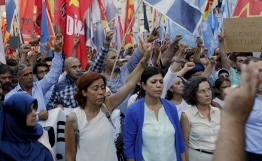
Turkish security forces have rounded up 1,050 suspected members of Islamic State, Kurdish militants and ultra-leftists in recent days, Davutoglu said, adding that 50-60 of them were foreigners. Local media reports said the vast majority were Kurdish and leftists, not members of Islamic State.