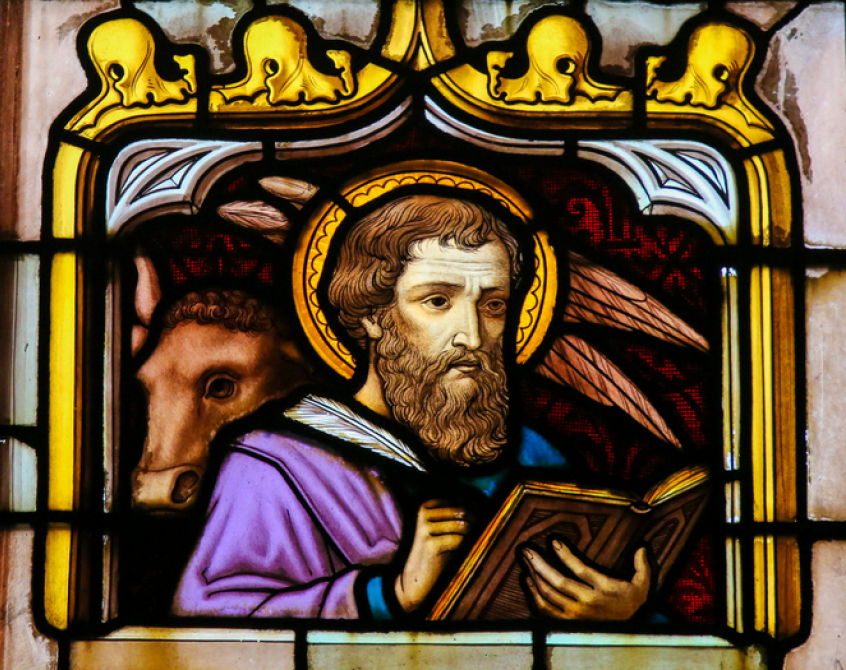
18 October is St Luke’s Day. This year’s observance has particular significance, marking the 500th anniversary of the first printed publication of Luke’s Gospel in English. This is the story …
Author
Luke is traditionally known as St Luke the Evangelist, recognised as the author of the two New Testament books traditionally known as “The Gospel According to St Luke” and “The Acts of the Apostles”.
These two books are like two parts of the story of the early Church: the story of Jesus followed by the emergence of his Church. By number of words in the original Greek, Luke is the longest book in the New Testament, closely followed by Acts. Together, they account for approximately 27%, or just over a quarter, of the New Testament. St Luke actually wrote more of the New Testament than St Paul did.
Who was Luke?
Unlike John or Matthew, who also wrote Gospel accounts, Luke was not one of the twelve apostles. Luke seems to have been from Antioch in Syria, and he had practised medicine before joining the Christian mission. His medical background may explain the detailed descriptions of illness and healing that appear throughout his Gospel, such as the healing of Simon’s mother-in-law (Luke 4:38-39) and the man suffering from dropsy (Luke 14:1-4).
Jew or Gentile?
Luke’s ethnicity is uncertain. The traditional view is that he was a Gentile Christian, and thus the only Gentile author traditionally associated with the New Testament. Others argue that his deep knowledge of Jewish Scripture, worship and customs points to a Jewish background, perhaps as a Hellenistic Jew. Interestingly, whichever view is correct, Luke’s Gospel is notable for showing how the message of Jesus extends beyond the Jews to all nations, a theme continued in Acts as the Gospel travels from Jerusalem to Rome.
Dedication
Luke’s Gospel is addressed to Theophilus, and the book of Acts starts: “In the former treatise (dear friend Theophilus) I have written of all that Jesus began to do and teach” (Acts 1:1). Luke is not named, but it is clear that Luke and Acts were written by the same person.
These two books were dedicated to Theophilus, and if we knew who Theophilus was, that might help explain which stories Luke included and why. Whilst it is not known for sure which Theophilus this was, Luke calls him “Most Excellent”, which is indicative of a high rank.
Some scholars speculate that it was Theophilus ben Ananus, who had been the High Priest of Jerusalem from AD 37 to 41. If this was him, then it might explain why Luke mentions his father Annas in Luke 3:2.
Luke Part 1: The Gospel According to Luke
It was his membership of the early Church which brought Luke into contact with eyewitnesses whose accounts he gathered and wove into his first book. Luke explains that his Gospel was based on the testimony of those who had been eyewitnesses of Jesus’ life and ministry (Luke 1:2). While Luke does not identify his sources, some of his distinctive material preserves memories originating with Mary, the apostles and other members of the earliest Christian community.
Unique features of Luke’s Gospel
Luke’s writings have left an extraordinary mark on Christian faith. Many of the best-loved stories in Scripture are found only in his Gospel. These include parts of the Christmas story, such as the annunciation to Mary (Luke 1:26-38), Mary’s song of praise, known as the Magnificat (Luke 1:46-55), the shepherds’ visit (Luke 2:8-20), and Anna and Simeon at the Temple (Luke 2:25-35). He also includes some famous parables, such as the Good Samaritan (Luke 10:25-37) and the Prodigal Son (Luke 15:11-32). Luke also uniquely includes some famous stories, such as Jesus meeting Zacchaeus (Luke 19:1-10) and the meeting on the road to Emmaus (Luke 24:13-35). These stories appear to preserve eyewitness traditions which Luke gathered and incorporated into his Gospel.
Luke’s themes
One of Luke’s distinguishing themes is God’s concern for those who are overlooked or marginalised. He pays particular attention to the poor, women, foreigners and social outcasts. His Gospel records Jesus proclaiming good news to the poor (Luke 4:18-19), welcoming sinners (Luke 15:1-2), commending the faith of a Samaritan (Luke 17:11-19), and promising salvation to Zacchaeus (Luke 19:9-10).
Luke shows Jesus reaching beyond cultural and religious barriers to bring healing, forgiveness and hope. This emphasis has led many scholars to describe Luke as the evangelist of mercy.
Luke’s Gospel places special emphasis on prayer. He alone records several occasions when Jesus prayed, including at his baptism (Luke 3:21), before choosing the twelve (Luke 6:12-13), at the Transfiguration (Luke 9:28-29) and in Gethsemane (Luke 22:39-46). He also preserves important teaching on prayer, such as the Friend at Midnight (Luke 11:5-13) and the Persistent Widow (Luke 18:1-8).
Luke Part 2: Acts
In his letter to the Colossians, Paul affectionately refers to Luke as “the beloved physician” or “our dear friend Luke, the doctor”, depending on the translation (Colossians 4:14). In 2 Timothy 4:11, traditionally understood as one of Paul’s final letters, Paul writes: “Only Luke is with me.” These brief references suggest that Luke was a loyal friend who remained by Paul’s side through hardship, missionary journeys and imprisonment. It was his links with Paul which enabled him to write about events in the early Church that Paul told him about or that he personally witnessed.
In his second volume, known traditionally as “The Acts of the Apostles”, Luke tells the story of how the Gospel spread from Jerusalem into the wider Roman Empire through the power of the Holy Spirit. Without Acts, Christians would know little or nothing about Pentecost (Acts 2:1-41), the conversion of Cornelius (Acts 10:1-48), Paul’s missionary journeys (Acts 13-28), and the growth of the early Church.
Acts gives the background to Paul’s epistles. For example, without knowing about the mission work at Ephesus as described in Acts 19, we would not properly understand the context for Paul’s letters to Timothy, whom he sent to Ephesus (1 Timothy 1:2).
When were they written?
It is not known when Luke drafted the books, but the events in Acts seem to end about AD 62, before the persecution of Christians under Nero in AD 64 and before the destruction of Jerusalem and the Temple in AD 70, which would have been mentioned if the story had continued. Therefore, some scholars wonder whether the books were first written in Rome about AD 63, whilst Paul was under house arrest there; whether they were written later in Greece or Antioch but reflect that period; or whether more of the story was written but did not survive.
Luke-Acts
It is not obvious to most readers that the books were written by the same author because they do not sit adjacent to each other in the traditional ordering of the New Testament, with the Gospel of John wedged between Luke and Acts. However, over the years, some publishers have put the two books together as a two-part volume, sometimes called “Luke-Acts” or “Luke and Acts”.
Tyndale’s Gospel of Luke
The year 2026 marks the 500th anniversary of the publication of William Tyndale’s complete printed English New Testament, which included both Luke and Acts. Copies printed at Worms were smuggled into England during 1526. Tyndale subsequently produced an extensively revised New Testament in 1534.
It is from Tyndale’s Luke that we first get the phrases used at Christmas: “Glory to God on high, and peace on the earth...” (Luke 2:14) and “Behold, I bring you good tidings of great joy” (Luke 2:10). In the Parable of the Rich Fool, Tyndale rendered the man’s words: “Eat, drink and be merry” (Luke 12:19). This phrase quickly entered common English and remains widely used today, often with little awareness of its biblical origin. Tyndale used the phrase “Signs of the times” (Luke 12:56), which is now used far beyond religious circles to mean evidence of broader social trends. These phrases remain familiar nearly 500 years later.
Tyndale’s Acts
It was Tyndale who gave us the phrase “Acts of the Apostles”; before then, Wycliffe had called the book the “Deeds of the Apostles”. Both work in English, but it is the word “Acts” which has stuck and set the name for all subsequent English translations.
Tyndale’s translation helped to establish familiar biblical uses of words such as “fellowship” (Acts 2:42), “apostleship” (Acts 1:25) and “uproar” (Acts 21:38). It also gave English readers memorable expressions, including “times of refreshing” (Acts 3:19), “the unknown God” (Acts 17:23), “unto the world’s end” (Acts 1:8) and “end of the world” (Acts 13:47).
St Luke’s Day
St Luke’s Day is observed on 18 October in the calendars of Western and Eastern Christian traditions. The feast is ancient, although the reason for the particular date is uncertain. According to Christian tradition, Luke died at Thebes in Greece in the late first century, traditionally at the age of 84. Because of his profession, Luke was later deemed to be the patron saint of doctors, physicians and healthcare workers.
Perhaps Luke’s own purpose statement remains the best invitation of all: he wrote “so that you may know the certainty of the things you have been taught” (Luke 1:4), or, as Tyndale put it, “that thou mightest know the certainty of those things, whereof thou art informed."