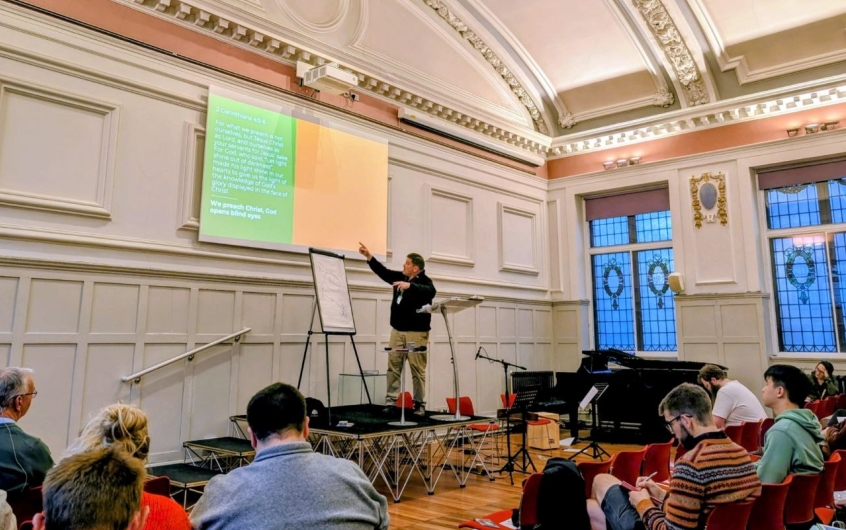
Dozens of church leaders gathered in Glasgow and online for The Evangelism Conference 2026 where they heard a sobering message from Rico Tice about what it will take to pass on the Gospel to the next generation.
Tice, a seasoned evangelist and co-founder of Christianity Explored, said that if Christians are serious about seeing more people come to faith, they need to embrace the “soldier’s life” and be “ready to suffer”.
“It’s a war,” Tice said.
“If you want to pass on the Gospel, it’s going to be brutal … Are we ready to battle?”
The Evangelism Conference was held at Tron Church and followed this week by a mirror gathering at All Souls Langham Place, London, with more churches joining online.
It was organised by A Passion for Life, a ministry dedicated to equipping churches for sharing the Gospel.
This year’s theme was “Pathways to Christ in a time of opportunity”, reflecting what organisers see as a “warming” of the spiritual temperature in the UK, especially among younger generations.
The aim of the conference was to help church leaders think about how they can “understand the cultural moment we are in and respond wisely”.
In his address, Tice encouraged church leaders to create a culture of mission and evangelism and adopt a comprehensive framework for preaching Christ not only from the front but through small groups, in the home, and one-to-one - the latter being particularly weak in British churches, he observed.
Speaking from his own experience, Tice said that Christians discipling people one-to-one could expect “exhausting” and “backbreaking” work, as he read from 2 Corinthians 5:14-15.
He said, “You are no longer your own. You are to give yourself. That's how the revival and the harvest is going to happen. Individuals have got to lay their lives down for other individuals.”
Making the case for one-to-one engagement, he said it allows church leaders to care for individuals, check how they understand and apply the Gospel, and model the Christian life.
“We don't just invite them to church; we invite them into our lives as well. Let's invite them to church, but bring them back for lunch afterwards. They've got to see us in our lives, in the mess of it,” he said.
Reflecting on what a culture of mission and evangelism means, he said that one aspect was helping congregations see that making disciples and nurturing people in the faith is “not just the pastor’s job”.
“We've all got to be doing it. Otherwise the pastor's going to have a breakdown, particularly at the moment when there's just so much going on in terms of the numbers of people that are hungry,” he said.
In his concluding remarks, Tice said the vision was for churches to “raise people that train other people”. This, he said, would require instilling a sense of “courage” within members of the congregation to invite people they know to church and to study the Bible with them.
“There are so many people that are hungry … We've just got to mobilise our church families to have the courage to have a go,” he said.
The Evangelism Conference was also joined by Phil Knox, a missiologist with the Evangelical Alliance, who senses that, after many “discouraging” decades, “the tide has turned and the seasons have changed.”
Knox pointed to evidence of increasing Bible sales and recent research by the Evangelical Alliance suggesting that Britain’s evangelical population is younger, bigger and more diverse than previously thought.
Sharing stories of growth from around the UK, he said this was happening in churches that consciously link their care and compassion ministries with personal invitations to attend a service or join a course exploring the Christian faith.
“What would it look like in our churches if every volunteer at every food bank and every toddler group was able to share their story, share their experience of Jesus, and talk about what they learned at church?” he said.
Knox encouraged Christians to think about their own sphere of influence as evidence from the Evangelical Alliance’s Finding Jesus study suggests that large numbers of people are finding their way to faith through friends, family members or other Christians they know personally, more than any church pastor or professional evangelist.
The “most significant barrier” is a lack of personal relationships with those outside the Church, he said, pointing to 43% of Christians in a 2022 study who said they did not know a non-Christian well enough to invite them to their church. He encouraged churches to invest in friendship and in training members of the congregation to share their faith.
Knox suggested that in the age of AI, coming to church in person and spending time with real people would only become more valuable.
“In that context, embodied community and real friendship and relationship matter,” he said.