Few parish churches are as famous as St Martin-in-the-Fields in central London. This year, it marks its 300th anniversary. This is the story …
The original church
As the name suggests, the original parish of St Martin-in-the-Fields lay in farmland outside London, but as London grew, it ended up in central London. It is not known when the first church was built, but the earliest recorded mention of it is from 1222.
St Martin
The church was dedicated to St Martin of Tours, who was a fourth-century Roman soldier who had a spiritual conversion as an adult. He is famous for giving half his cape to a poor beggar and then leaving the army when he renounced war to become a bishop. He is considered the patron saint of beggars. There are many churches dedicated to him, but St Martin-in-the-Fields is perhaps the most famous of all.
The medieval church
In medieval times, St Martin-in-the-Fields was a church run by the monks of Westminster Abbey. It was rebuilt in Tudor times. As London grew, so did the church congregation and the church building. In the eighteenth century, the original building was built of brick and had a tiled roof with a stone tower and buttresses, but it was in a state of decay.
The current church building
In 1720, Parliament passed the St Martin-in-the-Fields Act for rebuilding the church. The architect who was commissioned to design a new church was the Scotsman James Gibbs, and he took inspiration from other churches designed by Sir Christopher Wren.
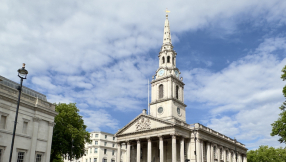
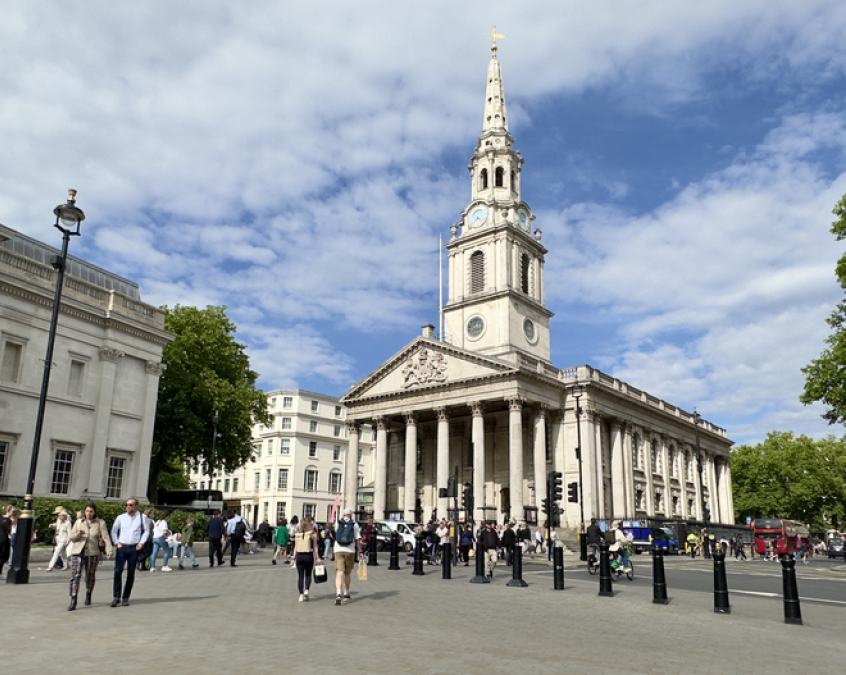
He designed a rectangular church with a west front built with a portico of six Corinthian columns and a Portland stone spire above. The foundation stone was laid on 19 March 1722, and the Gothic spire, which rises 192 feet above the floor, was added in 1724. Bells were cast in 1725, and the new church was consecrated 300 years ago on 20 October 1726 by the Bishop of London.
When it opened, the design was unique, but later the design became famous and inspired other churches around the world, such as St Andrew’s in the Square in Glasgow, but also St Michael’s Church in Charleston, South Carolina, and All Souls Unitarian Church in Washington, DC, and others across the British Empire. The church building is now a Grade I listed building.
Location
St Martin-in-the-Fields now has a prime position at the north-east corner of Trafalgar Square, near to the National Gallery and Charing Cross London Underground station. However, the church was there first, and it predates Trafalgar Square, which dates from the 1820s, and Charing Cross station, which opened in 1864. In the Victorian era, the church became very fashionable and is mentioned in the book David Copperfield by Charles Dickens.
Ministry under Dick Sheppard
The church came into prominence during the time that Rev Dick Sheppard was vicar, from 1914 to 1927. Dick Sheppard was ordained in 1908 and briefly served as a war chaplain, and his experiences led him to adopt pacifism. He came to St Martin-in-the-Fields late in 1914, when it was a fashionable church for the well-to-do. He was inspired by his war experience and by the story of St Martin to turn the church into a place where faith was put into action.
Seeing men going off to war and returning from war from Charing Cross, he opened the crypt as a refuge for soldiers, providing food, rest and hospitality. After the war, it was kept open for the homeless or people who missed the last bus home. In 1920, the church started an annual Christmas Appeal to raise money for vulnerable people. The church also acted as a social centre for those in need, and members of the church ministered to the local homeless.
Pacifism
After the Great War, Rev Dick Sheppard became involved in the peace and reconciliation movement, and he allowed sermons critical of the war and prayed both for soldiers from both sides and for conscientious objectors, which was unusual at the time. After leaving St Martin’s, Sheppard founded the Peace Pledge Union in 1934, which became Britain’s largest pacifist movement.
Connection with the BBC
After the BBC started in 1922, it was St Martin-in-the-Fields which provided the first Christian service ever to be broadcast, on 6 January 1924. In 1926, Dick Sheppard made his Christmas Appeal on the radio, and it has been held annually ever since. This year will be its 100th appeal.
St Martin’s was the church chosen by the BBC for regular religious broadcasting, and evening services were played on the BBC and across the BBC World Service. The radio broadcasts brought Dick Sheppard some fame, and his preaching attracted huge numbers. As the BBC expanded its religious output, it began broadcasting services from other churches around the UK, but it still sometimes broadcasts from the church.
Social justice campaigns
The church became the headquarters for the Church League for Women’s Suffrage, which sought voting rights for women. In 1928, it hosted a thanksgiving service when women finally gained the vote on the same terms as men.
Following the Sharpeville massacre of 1960, when South African police shot and killed anti-apartheid demonstrators, the church’s vicar, Rev Austen Williams, publicly condemned apartheid. The congregation became active supporters of the anti-apartheid cause, and the church also became a venue for anti-apartheid vigils and demonstrations, helped by its central position by Trafalgar Square.
It was originally gifted by King George I to the church of St Martin-in-the-Fields in London in 1726. It was supposedly a favourite instrument of Handel during his time in England. It was purchased from St Martin-in-the-Fields by the vicar of St Mary’s and moved to Wotton around 1800.
The Handel connection
Over time, the church became known for high standards of liturgical music and attracted distinguished organists and composers. One of the people connected to the church in the 1700s was the composer George Frideric Handel, who sometimes played the organ. The new church had a new, larger organ which was paid for by King George I, and Handel played at its grand opening in 1726. It was said to be his favourite organ, although he also played at St George’s in Hanover Square. When it was replaced in 1800, it was moved to the parish church of Wotton-under-Edge in Gloucestershire, where it is still played.
Concerts
The church’s concerts, recordings and broadcasts have introduced countless listeners to sacred music. In 1958, the Academy of St Martin in the Fields was founded by Sir Neville Marriner and John Churchill and gave its first concert in 1959. It became one of the world’s leading chamber orchestras and carried the church’s name to an international audience. Services, concerts and special events were transmitted nationally and internationally by the BBC, helping establish the church’s reputation as “the parish church of the nation”. Today, people visit the church for lunchtime and evening concerts.
The crypt
During the Second World War, when the Blitz started, St Martin-in-the-Fields turned the crypt into a public air raid shelter with a canteen for members of the armed forces. In 1948, St Martin’s formally established its Social Service Unit. From the 1970s, St Martin’s began moving away from providing direct overnight accommodation in the crypt and towards specialist support services beyond its walls.
The homelessness work evolved into what became The Connection at St Martin’s, which is now a separate charity focused on helping rough sleepers get off the streets into housing and support. The charity moved to a more practical base in nearby Adelaide Street, not in the crypt itself, which allowed the crypt to be redeveloped for other uses.
A café had existed there from at least the mid-20th century, and from 1987, parts of the crypt were deliberately developed as a cultural space and rooms for letting commercially to provide income for other services. From 2005, the crypt and underground spaces were extensively rebuilt and modernised, creating the café, shop, exhibition and event spaces seen today.
Legacy
St Martin-in-the-Fields has been a place where new ideas began. It pioneered religious broadcasting, working with the homeless, internationally famous music-making and charitable initiatives that spread far beyond London. Few parish churches can claim such a combination of architectural, musical, social and national significance as St Martin-in-the-Fields.
300th anniversary exhibition
St Martin’s likes to think of itself as at the heart of London and on the edge of Trafalgar Square. The church this year marks its 300th anniversary with a programme which includes worship, exhibitions, concerts, educational activities and community events that seek to connect the church’s history with its continuing mission.
There is also a free exhibition called St Martin-in-the-Fields: 300 Years at the Heart and on the Edge until 15 November, which is in the crypt.
Tercentenary service
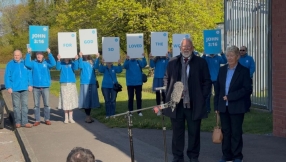
The church is also still a place of worship with regular Sunday and midweek lunchtime services which can be joined in person or online. There will be a special tercentenary celebratory service at 10am on Sunday 18 October. The service will feature a grand procession of charities and organisations that trace their origins to St Martin-in-the-Fields. Then there will be addresses from representatives of some of the organisations and a sermon from Revd Dr Sam Wells. The service will be followed by a reception.