Eastern Orthodox Churches are gathering shortly in Crete for a highly significant 'Holy and Great Council' aimed at ironing out knotty problems that have accumulated over the last few centuries. It begins on Saturday and supporters hope it will be something like the Second Vatican Council that blew away the cobwebs from the Roman Catholic Church and brought it into the 20th century (it started in 1962). However, the 'Pan-Orthodox Council' – it means all the Orthodox Churches – has run into problems. Several have said they won't be coming after all, and it looks as though it will be a bit of a damp squib.
I thought there was only one Orthodox Church, like the Roman Catholic Church.
It would certainly make life easier. No; there are 14 'autocephalous', self-governing Churches based on national boundaries or historical precedent. There are also some 'autonomous' Churches that are linked to a parent Church but run themselves. Orthodoxy is a tradition rooted in the Eastern, Greek tradition of the early Church Fathers, whereas Roman Catholicism looked to the West. Both accept the historical creeds of the Church, but they have developed in different ways.
And the Pan-Orthodox Council was designed to do what?
It was hoped that all the Orthodox Churches would come to a common mind on six contentious areas: the mission of the Orthodox Church in today's world, the Orthodox Diaspora, autonomy and how it is proclaimed, the sacrament of marriage and its impediments, the importance of fasting and the relations of the Orthodox Church with the rest of the world.
It's hard to see what could go wrong with all that.
They are all very complicated issues involving a huge amount of Church politicking. One of the main problems is that there is a fundamentalist wing in Orthodoxy that sees itself as being in a culture war with liberals, not just in society but in theological terms as well. So the preparatory document on the Church's mission in the world has a bit about peace and social justice, which is too liberal for some; and it talks about "inter-Christian cooperation", which too liberal for others. The 'Diaspora' is a sore point, too: it refers to Orthodox Christians living in places where there isn't really an Orthodox Church. So which Church has authority over them? Marriage is another difficulty; the preparatory document isn't remotely liberal on same-sex marriage, but some think it is. And several Churches think the council will give away too much to other Christian communions, which they don't think are Churches at all.
But surely all this could have been foreseen?
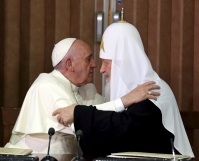
You'd think so. But this council has been a long time in the preparation, and some events have moved quite quickly. For instance, Russia's annexation of Crimea and incursion into Ukraine has outraged Ukrainians and helped split the Orthodox Church there. And the meeting between Russia's Patriarch Kirill and Pope Francis in Havana infuriated Russian conservatives, who accused him of selling out.
Are there other pressure points?
Qatar is one. Antioch and Jerusalem are at loggerheads because Antioch thinks it has jurisdiction over Qatar and the Qataris have given permission to a cleric from Jerusalem to build a church there. Another is the desire of the Bulgarian Church to get back the bones of King Samuel, who died in 1014. They are a present in a Greek museum, and the Greeks say they aren't giving them back. Then there's a row between the Serbian and Romanian Churches. There's a Romanian minority in Eastern Serbia, and the Romanians send their priests to minister to them; the Serbs say they will break communion with the Romanian Church unless they stop.
What next, an argument about the seating plan?
Funny you should mention that. At the moment there are two possible seating plans for the 500 participants. One emphasises the equality of all the Churches, and is the one preferred by Russia. The other emphasises the primacy of the Ecumenical Patriarch, based in Istanbul, the former capital of the Eastern Roman Empire. It's a very big issue for some Churches. And though the Ecumenical Patriarch is first in prestige among Orthodox Churches, it's tiny. The Russian Orthodox Church has many times its numbers and much more influence.
But presumably all this was known when it was decided to hold the council?
Yes, and perhaps in retrospect it was the triumph of hope over experience. But it looks as though these Churches want to use the council to make a point about their own local difficulties rather than putting them on one side for the greater good. The latest Church to announce its non-participation is the Georgian Church, joining the Bulgarians, Antiochenes and Serbs. Russia is still thinking about it. Whatever happens, it will not have the status of a true ecumenical council and Orthodox Churches will not be bound by what it says. It may be downgraded to a consultative meeting aimed at holding talks about talks.
Does this matter to anyone who isn't an Orthodox Christian?
Yes, it does, for three reasons. First, we are all members of one body, and these turf wars don't do the Church as a whole any credit. Second, in some cases religion is being co-opted for nationalistic purposes at just the time it's needed to be a voice for peace. And third, when there there is a crying need for Churches to make themselves fit for purpose in the 21st century, this looks like an opportunity missed. Many of those involved in planning for this council are men of huge wisdom, virtue and insight. We should pray that their voices prevail, even at the last minute.
Follow Mark Woods on Twitter: @RevMarkWoods