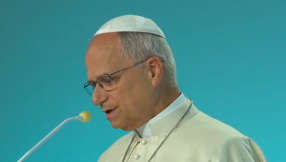
People say that spending time with someone is the best way to get to know them. I've been spending time this Advent - the weeks running up to Christmas - with Stephen Cottrell, who a few days ago was announced as the next Archbishop of York.
I've been rereading his 'Do nothing - Christmas is coming' book, published by Church House Publishing, and enjoying his daily reflections.
They have helped me gain an insight into the spirituality of the man who is currently Bishop of Chelmsford and will soon take on the big role of ministering alongside Archbishop of Canterbury Justin Welby at the helm of the Church of England.
The accessible slim volume, first published in 2008, carries a warm recommendation from broadcaster Jeremy Vine, who says "I'd listen to the still small voice of Stephen Cottrell any time."
Other people quoted in the book, aimed at readers who are not regular churchgoers, range from Andy Warhol to Anne Frank, Delia Smith and Andrew Marr.
Cottrell's style is to come alongside the reader and gently introduce them to the Christmas story and to the Christ who is the centre of the celebration. He wants to encourage readers to encounter Jesus, God with us, in a fresh way liberated from the usual consumer Christmas wrappings.
One of my favourite passages is when Stephen Cottrell recalls a Christmas Day service at the parish church where he was the vicar.
"About half-way through the service, a little girl, Miriam, toddled up to the front of the church. She can only have been about two or three at the time. For several minutes she stood before the crib, gazing intently at the figures. Then, very carefully, she stepped inside and sat down.
"So as people looked at the crib that Christmas, as well as the shepherds and the angels, and the ox and the ass, and Mary and Joseph and the baby Jesus, they saw Miriam. She sat there for the rest of the service, content to have become part of the story."
Cottrell challenges me, and all his readers, to become part of the Christmas story ourselves, saying "God comes to us in the vulnerability of a child. We can find him in silence."
He writes: "Christmas is the story of God's searching for us: and at last he speaks to us in a language we can understand, the language of another human life." Cottrell encourages his readers to respond to Christ, and to link up with their local church.
Following John Sentamu as Archbishop of York will not be easy. Archbishop Sentamu was a passionate communicator of the Gospel, who easily forged bonds of friendship with all kinds of people.
Having worked closely with Stephen Cottrell in my years as communications director of the Church of England, and having 'spent time' with him again this Advent, I believe that he connects with people both within and outside the church, and will use his many gifts to present the gospel afresh to new generations of seekers after faith and truth.
Rev Peter Crumpler is a Church of England priest in St Albans, Herts, and was Director of Communications for the CofE from 2004 to 2011.