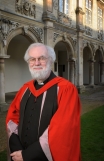
The former Archbishop of Canterbury has criticised our approach to retirement, saying older people currently face "a zero-sum game choice" between working "until they drop" or stopping altogether.
"That's it, one or the other," Lord Williams told the Telegraph.
"I'd like to see many more people supported instead to opt for a new rhythm of work when they reach a certain age, that is less hectic, less driven, but where they can still be and feel valued.
"At the moment there is too much of the attitude that you work-until-you-drop, or retire and die. That's not a real choice."
It's an issue close to the former Archbishop's heart, as patron of the Abbeyfield Society which works to help and care for older people. He believes that we should plan for our retirement strategically, without taking an 'all-or-nothing' approach to work.
"I've made all the assumptions that people of my generation do," he explained. "I have assumed that I can look forward to 10 more years of active life, but I have tried to think beyond that, so as to plan for the point at which it will be realistic to slim down, accept a greater degree of dependency and manage that pro-actively."
He added: "It's difficult to talk about this without sounding grating, but there is that tendency for us all as we get older to put off the moment of slimming down until we are forced to do so by a crisis."
Williams also insisted that our cultural attitude towards elderly people in general needs adjusting. "It is important to get away from the idea that ageing is just about loss, about becoming disabled or less active," he said.
"Yes, that does happen, but there is now an overall feeling that old age is universally terrible, and so we deny it, put off talking about it, and are even nervous of older citizens. But growing older doesn't have to be the end of the world, if approached intelligently and lovingly."
It is imperative that there is a shift in the language we use around the issue of age, Williams added. Elderly people should not be referred to as a "'drain' on resources," and should instead be cared for, and learnt from.
"There is a hectic and feverish obsession with youth that can lead us to use language that diminishes older people. I've heard myself do it, worrying aloud that there are not enough young people in the Church of England," he said.
"Older people internalise it when they hear it, and so you hear them worrying repeatedly that they don't want to be a 'burden' on others."