Candidly, on most political issues my instinct response to a strongly-held opinion is a sceptical "Really?" and an attempt to point out why things really aren't that simple.
However, I read Ann Widdecombe's Catholic Herald column today and frankly struggled. Widdecombe made an impassioned plea for the Government to stop sending £400 million in aid to Pakistan, in the light of its appalling treatment of Christians.
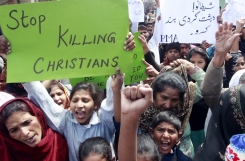
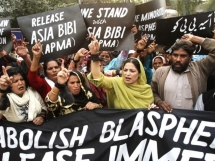
She retells many of the melancholy stories we have heard during the last few years. Shahbaz Bhatti, the minister for minorities, and Salman Taseer, governor of Punjab, were both murdered after speaking out for Christians. Asia Bibi is still in jail. She tells of another Christian whose brothers broke his legs after he converted and then hired men to kill him. He took shelter with his sister, whose home they then burnt and who died in the inferno. At this point his wife caved in, but he fled to Bangkok with his traumatised 12-year-old son. He is still in danger.
Christians are beaten, burned, fined and murdered. Some of this is local, the result of festering inter-communal prejudice fed by the ignorance and malice of so-called religious teachers. Some of it is structural, the result of the country's bizarre blasphemy laws – wrong in principle and in practice open to every kind of abuse.
So why, in God's name, are we paying so much to prop up a system which is fundamentally rotten, which is opposed to so many of the values we hold both as Christians and as citizens?
The usual answer, of course, is that we aren't – and we have to hear the strength of that argument. A similar criticism was made earlier this year by the former Bishop of Rochester, Michael Nazir-Ali, when it was found that £2 billion in British aid went every year to countries where it was hardest to be a Christian. A Department for International Development spokesman said then: "The truth is, stopping aid to these countries is counterproductive. It will simply cut support to persecuted men, women and children, and harm the future health, education and welfare of the world's poorest people."
And that's right too. Schools are good, and so are hospitals and wells and agricultural programmes – all the things that DfID actually does quite well. If Britain were simply to stop giving aid to Pakistan, it's the poorest of the poor who would suffer.
Furthermore, we can't just ignore the geopolitical role of Pakistan. Its policy regarding the Afghan Taliban, which amounted to running with the hare and hunting with the hounds, has proved to be a terrible error, but it is a crucial regional player. Destabilising it even further is in no one's interests.
But still. Given the sheer scale of the oppression faced by Christians and other minorities there, the chronic abuse of ordinary human values and the poisonous ideology that the instruments of the state are too afraid or to indifferent to challenge, it is hard to argue with Widdecombe's conclusion. She says: "The UN needs more courage and compassion, and so does Britain. The likes of Asia Bibi and every poor unknown soul suffering in obscurity will not be helped by pious words. We need to give our disapproval teeth through the age-old medium of filthy lucre."
Pakistan is not a failed state, which lacks capacity for change. It lacks the will. Britain's aid has so far done nothing to challenge the status quo. This cannot be allowed to continue.
Follow @RevMarkWoods on Twitter.