A number of Islamic terms have been banned from translation into English under a new law introduced by the Pakistani government.
The new legislation, approved by Prime Minister Nawaz Sharif on June 4, means that sacred Arabic names and words including 'Allah' (God), 'Masjid' (mosque) and 'Sala'at' (prayer) cannot be used in English.
According to website The Asian Age, the move has been commended by Islamic leaders in the country including Muftis Muhammad Naeem and Muneebur Rehman. Naeem said the decision should be "enforced in letter and spirit", the website reported, while Rehman agreed that "some religious terms and names are best described in Arabic".
The legislation comes in the Islamic holy month of Ramadan, which began on June 18.
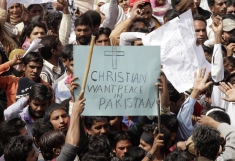
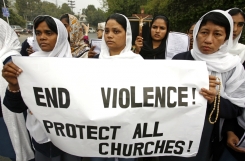
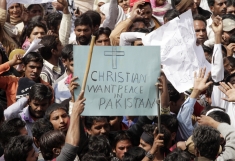
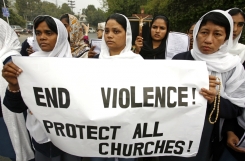
Christians in Pakistan are regularly subjected to religious discrimination, and Nasir Saeed, director of the Centre for Legal Aid, Assistance and Settlement (CLAAS) which works to improve religious freedom in the country, has warned that the new law could have a significant impact on minority faith groups.
"Keeping in view the present situation of the country where extremism, fundamentalism and hatred against Christians and other religious minorities is on the rise...there is a possibility that this policy could have a negative impact, especially on the lives of non-Muslims who are already suffering because of the government's discriminatory policies against them," Saeed said.
"There is also the chance that people will misuse this provision if they consider any translation of any word offensive or insulting to any Islamic word."
Saeed also suggested that it may not be a coincidence that the legislation's announcement "was made just one day before the anniversary of General Zia's 1977 coup which saw the elected prime minster thrown out, and then in an attempt to Islamise the country and its laws, push the country into further darkness.
"It is not surprising the policy has come from Mian Nawaz Sharif, as he is the prodigy of Zia," Saeed added.
The US Commission on International Religious Freedom (USCIRF) in May urged the Obama Administration to designate Pakistan a "country of particular concern" and also blamed the Pakistani government for failing to provide adequate protection to targeted groups.
"Pakistan's legal environment is particularly repressive due to its religiously discriminatory constitutional provisions and legislation, including its blasphemy laws," the USCIRF's annual report said.
Human rights groups say that the blasphemy laws in particular are frequently misused by extremists, and false charges are often brought against Christians in order to settle personal scores or to seize property or businesses. Two Muslim clerics have been arrested for inciting violence after a mob tried to murder a Christian couple accused of committing blasphemy in Punjab on June 30.
The couple's sleeping mat allegedly carried an advertisement that included Arabic inscriptions from the Quran.