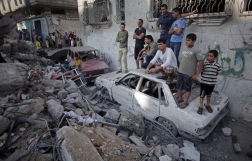
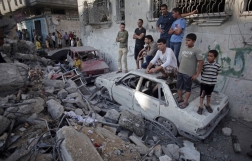
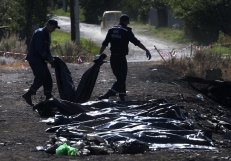
With the news this week, it may seem inappropriate to be talking about the Genocide Texts in the Old Testament. Israeli ground forces clear their way through Gaza and a direct missile attack on the al-Asqa martyrs hospital left many Palestinians dead, barely a week after F16 bombers blew up a beach killing four Palestinian boys playing football. Some might be fearful that by discussing genocide, Christians are simply going to offer theological support for Israel's actions – but nothing could be further from my intention. Israel has received a lot of criticism for their military response and in my opinion this critique is needed. But there can be no doubt that the indiscriminate use of rocket attacks by Hamas on Israeli targets is equally unjustifiable.
My seminar at the Kewsick Convention this week "The Joshua Paradox – the God who is terribly compassionate" did not criticise Israel and cheer on Palestine. Like so many people I felt traumatised as I heard the stories of what's going on in Gaza. As a father I was deeply moved by pictures of the grieving father inconsolable at the loss of his sons and also seeing the images of 12-year-old Abdul Rahman Al-Batsh sitting on the floor next to a 4x4 screaming after losing 18 members of his family – including his father – struck a chord with me as a lot of my work is to try to help vulnerable children find adoptive and foster homes. Yet at the same time I can't imagine the trauma that Israelis are facing living in the constant fear of a missile attack.
What I wanted to do in the seminar is focus on trying to explain how it is possible that a God of love could have possibly encouraged his people to annihilate the Canaanites in Old Testament times. How can a God who is supposed to love the whole world ask his people Israel to exterminate another people that are supposed to be precious to him? Throughout history Christians have attempted different ways to reconcile this paradox:
Option 1: The Genocide did not happen they were merely figurative
Option 2: Israel (deliberately?) misheard God's command
Option 3: God was mean in the Old Testament and became nice in the New Testament
None of these seem to honour the character of God or the integrity of the scriptures. In both my seminar At Keswick and the Joshua Paradox chapter in my new book Paradoxology, I look to find a way to reconcile a good and loving God, a holy God and a reliable Bible.
In order to work out how to reconcile the God who is love with his command to wipe out the Canaanites we need to get a larger perspective. We need the canonical perspective where we understand the wider context of what God had been doing in the history of Canaanites and his patience with them over many hundreds of years. We need the historical perspective of how warfare was conducted in those days and how God might have accommodated to some of the norms of ancient warfare. We need to look at the geographical perspective – what kind of city or perhaps citadel Jericho was. These perspectives do not sanitise what happened, but they do help us understand a little about why God might have commanded his people to do such a thing.
But there is one more inescapable perspective of what took place in the Jericho incident: the judgement perspective. God is using Israel as an agent of judgement on another nation. This must be handled carefully or pretty soon we will find people who will try and apply this thinking to the modern nation state of Israel. God was not offering Israel a carte blanche to attack their enemies but instead, at a point in history He used them as a means of judgement. What is striking is that by the time we come to the book of Habakkuk God is using another nation; the Assyrians, as a means to punish Israel. This week a friend of mine Eddie Arthur, former director of Wycliffe Bible Translators, tweeted a telling comment:
I can only assume that those Christians who believe you should never criticise Israel have never read theOld Testament prophets.
— Eddie Arthur (@kouya) July 19, 2014 " data-caption="null" data-credit="null">Israel was not given carte blanche by God to do as they wanted. In the Old Testament they were held accountable by God and criticized often for their lack of compassion to the needy, the stranger and the orphan. God does not belong to any nation. He does not automatically back any side in any wars, he refuses to be used as a mascot for any one side. God will one day hold all people accountable where ever we live whatever our ethnic background.
In the middle of a week of global tragedy I have been thinking that human beings are not counters in a game of Risk. Passengers sitting on a flight are not acceptable targets. Children playing on a beach or people living in a certain part of Israel are not collateral damage for a political system or even an ancient narrative about land rights.
The Genocide passages in the Old Testament are difficult to read, but they do at least hint at the holiness of God who will one day call all people and all acts of violence to account. This perspective helps me keep on trusting that the judge of all the earth will do right.
Taking a closer look at the awkward and difficult parts of the Old Testament is important for all Christians. We want to be wary of the misuse of these texts to justify unjustifiable things – including how some believers talk about what's going on in the Middle East. At this stage in God's dealings with humanity, our role must be to show mercy, grace and respect to all people of all backgrounds, and call for justice and peace, and peaceful solutions to the conflict in Gaza.
Krish Kandiah is author of Paradoxology: Why Christianity was never meant to be simple (Hodder Faith). He is executive director of churches in mission at the Evangelical Alliance and founder of Home for Good, a charity exploring how the church can make adoption and fostering a normal part of church life.
Keswick Convention's mission is to unite with Christians around the world to commit to three big priorities for our lives and churches – hearing God's Word, becoming like God's Son, and fulfilling God's mission.