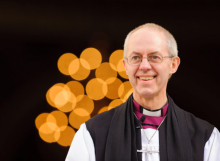
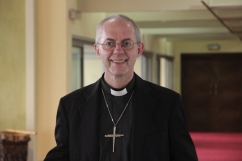
"A society with a clear moral compass will handle money fairly and justly," the Archbishop of Canterbury told a group of bankers in London today.
Speaking at the 'Financial Inclusion: The next move forward' conference, Welby thanked his hosts HSBC and Lloyds, noting that it was "brave" of them to open up dialogue about the issue. There are 2.5 billion people globally without access to formal financial services. Thirteen per cent of UK households with an income below £10,000 don't have a bank account, compared with five per cent of all households.
"Speaking from personal experience in the church, the process of listening to those who disagree with you, sometimes extremely strongly, is never a pleasant one, but is occasionally useful," Welby said.
The Archbishop has been vocal in his call for financial equality in the UK, and in November launched a plan to take on payday lenders. His 'To Your Credit' initiative aims to resource and equip churches and Christian organisations to help people cope with their finances "as a servant, not as a really cruel master".
Speaking today, Welby criticised high-cost credit initiatives and what a police official had described to him as "the golden age of the loan-shark".
"Progress has been made, very dramatic progress. The FCA [Financial Conduct Authority] has taken action against the usurious interest charges levied by too many lenders, but there is still much more that can be done," he said.
Welby added that we must make sure we have the right priorities when considering financial inclusion for all. It is the "fundamental infrastructure of a good society," he said.
"It is essential to ensure that financial services are people-centred. They are called financial services for a reason – they need to serve. Financial inclusion is a basic necessity for dealing with deprivation and poverty. It is part of the fundamental infrastructure of society. Access to employment is key to escaping poverty."
The Archbishop noted the discrepancies between job creation in London and the south-east compared with the rest of the country. A report released today showed that on average, 12 jobs are created in London for every one elsewhere. "It is something that has defeated every government and every economic approach since at least the early '60s," Welby said.
In response, he called for more help for small businesses, which "increase the level of well-being and human flourishing in areas of poverty."
"Without good access to normal banking services, economic life in a local area will diminish and almost disappear," Welby warned. "Inclusion must not be by means of charity, because that is never going to be sustainable. Nor can it be seen as an opportunity to maximise financial return for service providers, because that would be unaffordable for those who use it. A society with a clear moral compass will handle money fairly and justly."
Welby challenged senior figures in banking to "take the lead" in that area, and encouraged them to establish banking which is "people centred and not simply bottom line centred."
"Of course profits have to be made, but they need to be measured not only in terms of their absolute return on capital employed, but also in terms of the human cost of achieving that return," he said.
Everything should be "secondary to human dignity", the Archbishop added, underlining that it is a value "rooted in many faiths and especially in our Judaeo-Christian tradition."
He therefore called on banks to "stand in the gap" while initiatives such as credit unions gain momentum. He noted that this may not make economic sense, but "all good moral choices have a cost".
"There is a myth that good morality is profitable. It may be, but that is purely coincidental. It is always worth it, even when it costs," Welby concluded.
"The best example of moral and ethical action in history, in the most extraordinary figure of world history, Jesus Christ, required the sacrifice of everything to gain a world. We are not asking the banks for that, but for a commitment to a society with a moral compass that points towards people first and foremost."