Many of Iraq's minorities are on the verge of disappearance after 13 years of war, campaigners warned on Monday.
"The impact on minorities has been catastrophic. Saddam was terrible; the situation since is worse. Tens of thousands of minorities have been killed and millions have fled for their lives," said Mark Lattimer, head of Minority Rights Group (MRG).
Iraq's Christian population, which before 2003 numbered as many as 1.4 million, is now under 250,000, according to a report by MRG and other rights organisations.
Civil conflicts and sectarian tensions have engulfed the country since 2003 when a US-led coalition toppled Saddam Hussein. In 2014 Islamic State militants declared a caliphate after capturing swathes of Iraq and Syria.
Minorities including the Yazidi, Turkmen, Shabak, Christians and Kaka'i have been disproportionately affected by the recent violence, the report said.
Tens of thousands have been murdered, maimed or abducted and many women and girls forced into marriage or sexual enslavement.
"One cannot say anything positive about Saddam – he was a genocidal dictator – but for many minorities the situation is now much worse," said co-author Lattimer.
The Yazidis hit the headlines in mid-2014 when Islamic State militants attacked them in northwest Iraq, killing, capturing and enslaving thousands.
The jihadist group has shown particular cruelty to the Yazidis, whom they regard as devil-worshippers.
Most Yazidis, along with another minority called the Kaka'i, have been forced from their traditional lands. Also highlighted, is the plight of the Shi'ite Turkmen and Shabak communities who have been driven south.
Mass graves
The report demands an end to impunity for crimes against minorities. It says planning should begin immediately for a post-Islamic State era to enable them to return to their homelands.
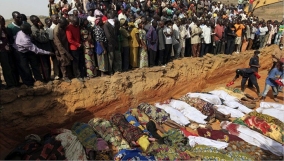
It also calls for the protection of mass graves in areas captured from Islamic State and the deployment of forensic teams to investigate possible war crimes.
The report, No Way Home: Iraq's Minorities on the Verge of Disappearance, says Iraqi security forces and Kurdish peshmerga forces have also committed war crimes.
An estimated 3.4 million people are now uprooted inside Iraq. And as many as one in five displaced Iraqis interviewed by researchers felt they had no choice but to flee the country because of the lack of basic services and security.
The authors warned that displacement could soar with an assault to retake Mosul from Islamic State, potentially uprooting another 1 million people and creating hundreds of thousands more refugees.
Lattimer said the upcoming Chilcot report on Britain's role in the Iraq war should reflect the devastating long-term consequences for Iraqi society. The long-delayed report is to be released on Wednesday.
"Chilcot is expected to criticise 'post-invasion planning' but the UK government's biggest – and continuing – mistake has been to support successive Iraqi governments since 2003 in a sectarian war that has cost tens of thousands of civilian lives on both sides," Lattimer said.
The report on minorities is published by MRG, Unrepresented Nations and Peoples Organization, the Institute for International Law and Human Rights and No Peace Without Justice.