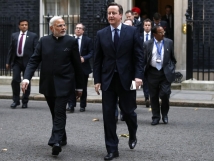
For more than a month now the swell of the Dalit (sometimes called "untouchables") uprising has grown across India. Riots stir main streets and town centers, protesters clash with police, and a war of words has begun. India's Prime Minister, Narendra Modi, is locked in everyone's bull's eye.
"What right do these gau rakshaks [cow protectors] have to treat the Dalits and poor in this manner? If they want they can shoot me, but please don't target my Dalit brothers," said Modi on August 8, referring to an incident in July where four Dalits were publicly beaten for skinning a cow.
Following his remarks, several Hindu right-wing groups, who represent the so-called 'cow vigilantes', threatened Modi, saying he would pay a price for his remarks in the next general election. This threat comes as a personal blow to the Prime Minister, whose political roots reach all the way into these groups.
Yet he is not only under fire from the groups he spoke against.
The Dalits who are revolting across India are also attacking Modi because they see his statements as weak and coming too late. They are seeking a much deeper reform that consists of more than words. They want land – which is their right under government provisions – so they can seek alternate professions and employment and leave the degrading jobs of discarding animal carcasses and cleaning sewers.
So what will Modi do as he is attacked on both sides?
He must stand by his statements and implement the laws that penalise the discrimination of Dalits. I also believe he needs to remain true to his vision of an India for all, not just for one religious community. With full respect to all those who want to worship the cow, the Prime Minister must be able to defend the hundreds of millions who hold another faith view.
Modi's ascension to power in 2014 was a historic and revolutionary event. He used social media and even holographic projections to appeal to India's youth, and he became one of the world's most followed leaders on Twitter. In the end, he won the vote of right-wing Hindus, progressive Muslims, Dalits, Christians, and Sikhs because he promised to bring massive economic development and tackle corruption. His victory upturned the political majority ruling the Indian parliament.
If one thing was clear about Modi's election it is this: both India's tech-savvy youth and the traditional forbearers of the nation were ready for change.
Today, we are all still hoping for that change. But it's clear that India needs social reform before achieving the economic prosperity Modi has worked to achieve.
The late Lee Kuan Yew, the first Prime Minister of Singapore, spoke about this in his book One Man's View of the World: "It is with sadness that I make these observations about India... India is trapped by the almost unchangeable realities of its internal composition and the persistent grip of the caste system."
Modi needs to grasp this fundamental fact from Yew's comment: economic development goes hand in hand with social development. In fact, social equality and religious freedom breed economic empowerment and growth.
If Modi is concerned that taking a definite stand on the Dalit issue will have a negative effect in the next elections, he mustn't be.
He will find that the majority of India will continue to support him electorally if he fights for freedom and equality. India knows it cannot be divided anymore and that development is the key to her livelihood and future. As India's Nobel laureate, professor Amartya Sen, recently said: "Caste is anti-national because it divides the nation. We want to be national, not anti-national, for which it is important to eliminate all divisions."
The dam of the caste system has finally cracked. This is the time for our nation to be reborn as the world leader she was truly intended to be.
Dr. Joseph D'Souza is the Moderating Bishop of the Good Shepherd Church and Associated Ministries of India. He also serves as the President of the All India Christian Council and is the founder and International President of the Dalit Freedom Network.