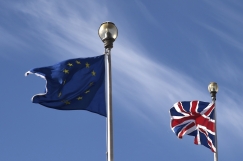
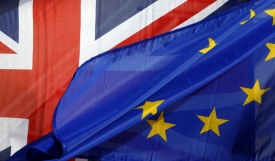
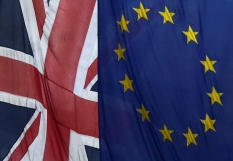
European Union officials and diplomats launched a round of confidential discussions this week to prepare a coordinated response to a possible British vote to leave the bloc next month.
Senior diplomats from founding powers Germany and France, as well as several other countries, met on Monday for talks chaired by European Commission President Jean-Claude Juncker's chief of staff, Martin Selmayr, several sources told Reuters.
One source with direct knowledge of Monday's discussion said it was intended to be followed by others on specific topics.
The Commission and representatives of those governments present at the meeting declined official comment. Britain, the EU's second biggest economy, was not present.
EU institutions and Britain's 27 partner states have been at great pains to avoid discussing in public the possibility that Brexit could actually happen, for fear of fuelling a Leave vote. Many senior officials admit in private they have no clear idea how events might unfold on the morning after.
While officials have acknowledged that informal discussions have been going on to consider how to react to what would be a political earthquake felt across Europe, Monday's meeting was a first confirmation of a more formal planning process.
Another source said the aim was not to prepare for the unprecedented, years-long negotiations that would be needed to unpick 43 years of British EU membership. Rather officials wanted to be ready to coordinate what kind of first response, especially what communication strategy, would be needed in the hours and days after an "Out" vote.
"The idea is to have something prepared, not leave it for the day after June 23," a third source said.
Slovakia, which takes over the EU's rotating presidency in July, was among countries present at the meeting, sources said. Several added that no clear conclusions were reached on Monday.
A spokesman for the Commission, and French and German representatives, declined to comment on the meeting. The Commission spokesman stressed the EU executive was preparing for Britain to maintain its membership of the 28-nation bloc.
"We don't have a Plan B," said Alexander Winterstein.
European leaders have postponed a regular EU summit that should have been held on June 23-24 until June 28-29, to give themselves four days to digest the result of the British vote.
If the Leave campaign wins, officials expect the European Central Bank, the Bank of England and others to be ready to respond to heavy market volatility on Friday, June 25.
Sterling has dropped when opinion polls have tended toward Brexit but has strengthened to 3-1/2 month highs as Remain's lead has firmed in polls which are still uncertain.
If Britain votes to leave, the 28 European Commissioners -- one from each state, including Britain's Jonathan Hill -- would probably hold an emergency meeting on Sunday, June 27, EU officials say. They would prepare a strategy before the meeting of EU state leaders on the Tuesday.
"The idea is to have everything ready for the Monday," one EU source said of plans to coordinate a response in Brussels.
"There will be a lot of talk about the show goes on," said another. "There will be expressions of regret, of respect for the wishes of the British people, and probably some dire warnings about consequences to discourage others from doing the same.
"It will be important to coordinate who says what when, and for the EU, minus Britain, to be seen speaking with one voice."
Some diplomats speculate that France and Germany, who drove the foundation of the EU after World War Two, could announce new areas of closer integration in the bloc without Britain. But big differences between Paris and Berlin, both preparing for national elections next year, mean few expect substantial new plans to deepen cooperation in the euro zone.
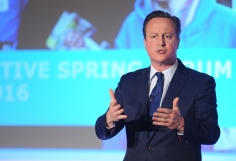
Cameron has said he would act on a Leave vote "immediately" to trigger a process, set out in Article 50 of the EU treaty, to launch negotiations for Britain to withdraw. The treaty sets out a two-year period for talks, after which Britain would be out unless all states agreed to an extension -- a scenario many British and EU officials and diplomats say is unlikely.
Questions remain about how Cameron, who is widely expected to resign if he loses, will deliver Britain's request to leave.
Assuming he has not been replaced by a new leader by June 28, he might deliver it to the summit in person. But some diplomats question whether he would have the authority to trigger Article 50 talks as a caretaker premier.