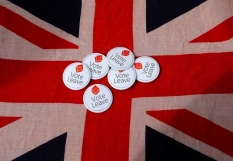
I suspect that I am not alone in often finding the arguments on each side of the referendum campaign unhelpful and the passion of their advocates rather perplexing. An added challenge is how to approach making a decision on June 23 as a Christian. This is obviously something most campaigners are not addressing, although there are now a number of helpful resources online at Reimagining Europe, KLICE and Evangelical Alliance.
Seek the welfare of...Europe?
As we think about how to vote, there are many pressures on us to think of ourselves and to do so predominantly, almost exclusively, in narrowly economic terms. Will I better be better off or worse off if I vote X? A Christian perspective on our responsibilities as voters calls us to think much wider and deeper – not just about money, not just about ourselves. As those called to love our neighbour we are called to think about the common good when we cast our vote. Our national common good clearly has a significant place in that but we must not think of ourselves alone. We must consider the international common good, the impact of our decision on other countries in Europe and the wider world. That will mean wrestling with the reality that actions which benefit us may harm others, and vice versa.
A relationship to work at or to leave?
A Christian commitment to working at difficult relationships with others speaks against rupturing relationships or advocating self-sufficiency and isolationism. There is, in that sense, a presumption in favour of staying in a relationship and seeking to make it work better. But that presumption is far from absolute. We all know that some relationships are destructive of those in the relationship or of those excluded from it. Such relationships often need to be left in order to try to re-establish a relationship on a new and better footing. So, although some have argued that neighbour-love requires Christians vote to remain, I'm not convinced. Could it not be argued that the EU structures are damaging not just to the UK but to other member states, and perhaps the wider world, and that the shock of Brexit is good as it forces us to address our deeper problems in the EU?
But what about the specific issues? One problem is that there are so many (I explore a number in The EU Referendum: How Should We Decide?, Grove Books) but the EU is primarily a political and law-making community. So how might a Christian perspective on politics help? Two central questions are what political authority and law-making should be seeking, and who exercises such authority.
The EU and seeking justice
What should guide political decisions, including the decision on how to vote in the referendum? From a biblical and traditional Christian perspective, the task of political authority is to pursue justice by upholding the common good. That means a central question – though one rarely raised in the popular debate – is whether this goal is better fulfilled by remaining in the EU or leaving it. Most of us, if asked to name threats to justice and the common good, are likely to include at least some – such as damage to the environment or international terrorism – which are transnational. This seems to point to the need for the EU or some similar multi-national structure if national governments are to respond and work for justice effectively. A major but largely unconsidered question is what leaving would entail in relation to justice and these areas rather than just the narrowly economic consequences of Brexit which dominate the news.
The EU and representation
But it's also important to ask who is taking political decisions and making laws. In traditional Christian thinking, those with such authority are to be representative of those over whom they exercise authority. This is a challenge if we see the real need for political structures at a trans-national level in the pursuit of justice. It's clearly a challenge for the EU. At one level this is the problem of the "democratic deficit" within the EU institutions and the low turnout even for the one institution – the European Parliament – which is directly elected. There is though an even more serious challenge. Particularly given the EU's massive recent expansion, do its 28 member states and more than 500 million citizens have enough of a shared identity, a real sense of belonging together, to be able to see any political institutions as genuinely representing them?
One solution the EU has embraced is the need for subsidiarity. This comes from Christian political thought and means, at a bare minimum, political decisions are taken as near the people effected as possible. It favours decisions being made by local and national governments which can be more representative and accountable than larger, more distant, transnational institutions. It is, though, far from clear that this theoretical commitment has been put into practice within the EU.
These two elements of a central aspect of the EU – its nature as a political institution – show how Christian thinking helps identify issues often not given prominence and brings a distinctive perspective to them. Sadly they also show why for many of us, this cannot be a simple black and white choice but is instead a complex one requiring much reasoned discussion and careful and prayerful discernment.
For those interested in such discussion and discernment there is an event at St James the Less, Vauxhall Bridge Road, Pimlico, London on Friday, May 20 with Ben Ryan and Giles Fraser speaking for Remain and Leave.
Rev Canon Dr Andrew Goddard is senior research fellow at the Kirby Laing Institute for Christian Ethics (KLICE), Cambridge, and assistant minister of St James the Less, Pimlico.