In America, police can gun down a 12-year-old boy playing in a park without facing a trial. That boy, Tamir Rice, wasn't even holding his toy gun at the time. Within seconds of arriving on the scene the police pumped bullets into him and left him to painfully bleed on the ground in terror while they handcuffed his sister for the crime of wanting to comfort her dying brother.
This was an unmistakable injustice that should be of special concern to evangelical Christians who believe that we are created in God's image and that God is especially concerned with justice. In fact, a large number of evangelicals involved in InterVarsity Student Fellowship are deeply involved in advocating against such instances of police violence.
American evangelicalism is in danger of becoming relevant again.
But that doesn't mean culture warriors manning the walls won't sound the alarm over advocacy polluting their "pure" doctrine.
In fact, if there's anything that can keep American evangelicals from rallying to join in so critical a cause – a cause that demands black lives be treated with the same reverence that white lives have long enjoyed – it's our obsession with doctrinal boundaries and the purity of our creeds and statements.
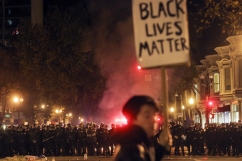
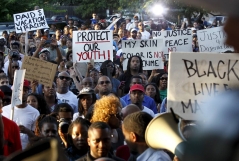
Michelle Higgins, director of Faith for Justice shared at InterVarsity's Urbana Conference, "Black Lives Matter is not a mission of hate. It is a not a mission to bring about incredible anti-Christian values and reforms to the world. Black Lives Matter is a movement on mission in the truth of God."
However, InterVarsity quickly followed her address with a statement loaded with evangelical insider language that aimed to both knock Black Lives Matter down a peg, while providing assurance that InterVarsity is still pure in its doctrine. It mentioned that the #BlackLivesMatter movement has been attributed with statements that dehumanise and attack police, something that any committed activist would vehemently deny and that stands as a rather vague way of shrugging one's shoulders about what this movement actually stands for.
Instead of saying that some people attribute terrible things with Black Lives Matter, let me Google what the movement says on its website.
According to the home page: "#BlackLivesMatter is an online forum intended to build connections between Black people and our allies to fight anti-Black racism, to spark dialogue among Black people, and to facilitate the types of connections necessary to encourage social action and engagement."
The About page adds: "#BlackLivesMatter is working for a world where Black lives are no longer systematically and intentionally targeted for demise."
It's not an act of violence or aggression to demand that our legal system hold police officers accountable to the same laws they enforce.
The InverVarsity statement obsessively uses evangelical code words implying their pure doctrine right from the start. I'll underline these words in the opening paragraph: "InterVarsity Christian Fellowship/USA has a 75-year dedication to the gospel, orthodox doctrine, and missions while also sharing the message in a way that resonates with the current student generation. Scripture and the gospel are non-negotiables for us. Some of our chapters have been denied access to campuses because of our dedication to core, orthodox Christian doctrines."
I don't disagree with these statements. Rather, I don't see how they are remotely necessary after publicly voicing support for a group with a primary mission of ending disproportionate violence against black people.
While I applaud InterVarsity for not completely backing away from #BlackLivesMatter and for addressing racial justice in the first place, the fact that this statement had to be written at all shows just how flawed and irrelevant segments of evangelicalism have become for large parts of America. Since when did justice for the marginalised threaten one's doctrinal commitments?
Thankfully, InverVarsity is far from uniform in their views on this statement. In fact, law professor and InterVarsity board of trustees member John Inazu wrote in response, "Finding common ground does not mean endorsing every goal or every value of the people to whom we draw near. But it does mean drawing near. That is at the heart of the vision of what I have called 'confident pluralism.' That vision is a challenge to enter into the reality of pluralism around us to find common ground. And we can do so out of a confidence in our own beliefs."
Take note that Inazu was careful to address "beliefs" once again, but that was an assumed footnote rather than the substance of his remarks. In addition, a large number of evangelical leaders, including denominational and organisational leaders, signed an open letter at Sojourner's in support of InterVarsity's embrace of #BlackLivesMatter at Urbana.
Our beliefs and doctrines matter, but if we fail to love our neighbors, including advocating for those slain unjustly, scripture itself indicts us (Proverbs 31:8-9, Isaiah 61:8-11).
America's justice system may turn a blind eye to a 12-year-old boy bleeding to death in a park from a police officer's unnecessary bullet, but the Bible assures us that God won't. It's time for evangelicals to stop defending our doctrines rather than jumping to the aid of those treated unjustly and with excessive force. If our beliefs are going to do us and our world any good, we need to follow the lead of Michelle Higgins, John Inazu, and the InterVarsity leaders who are guiding us to God's justice and care for those experiencing injustice. Using our doctrines as an excuse to hold back only means we've lost touch with the heart of the God we claim to defend in our statements.
Ed Cyzewski (MDiv) writes at www.edcyzewski.com. He is the author of A Christian Survival Guide and Pray, Write, Grow: Cultivating Prayer and Writing Together.