With a nod to ongoing U.S. racial tension and threats to voting rights, President Barack Obama declared the work ofthe Civil Rights Movement advanced but unfinished on Saturday during a visit to the Alabama bridge that spawned a landmark voting law.
Obama, the first black U.S. president, said discrimination by law enforcement officers in Ferguson, Missouri, showed a lot of work needed to be done on race in America, but he warned it was wrong to suggest that progress had not been made.
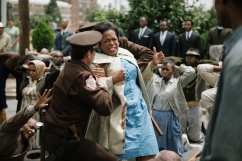
"Fifty years from Bloody Sunday, our march is not yet finished, but we're getting closer," Obama said, standing near the Edmund Pettus Bridge, where police and state troopers beat and fired tear gas at peaceful marchers who were advocating against racial discrimination at the voting booth.
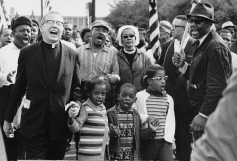
The event became known as "Bloody Sunday" and prompted a follow-up march led by civil rights leaderMartin Luther King Jr. that spurred the 1965 Voting Rights Act.
"The Americans who crossed this bridge, they were not physically imposing, but they gave courage to millions. They held no elected office, but they led a nation," Obama said.
"What they did here will reverberate through the ages ... because they proved that nonviolent change is possible."
Related
After his remarks, Obama and his wife Michelle, daughters Malia and Sasha, and mother-in-law Marian Robinson joined some of the original marchers along with former President George W. Bush and his wife, Laura, to walk across the bridge.
The marchers sang songs including "We Shall Overcome" as a crowd of some 40,000 people looked on.
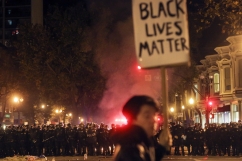
The anniversary comes at a time of renewed focus on racial disparities in the United States, including discrimination from police against black citizens nationwide.
Obama condemned the city of Ferguson on Friday for "oppressive and abusive" actions against black residents that were revealed in a U.S. Justice Department report accusing police and court officials of racial bias.
On Saturday, he criticized efforts to limit voting rights that have sparked a clash between Republicans and Democrats across the country.
"Right now, in 2015, fifty years after Selma, there are laws across this country designed to make it harder for people to vote. As we speak, more of such laws are being proposed," he said. "Meanwhile, the Voting Rights Act, the culmination of so much blood, so much sweat and tears, the product of so much sacrifice in the face of wanton violence ... stands weakened."
Rev. Raphael Warnock, the 45-year-old pastor of the Atlanta church led by King at the height of the Civil Rights Movement, lamented that the measure was now in limbo.
"I'm glad to see a parade of politicians here, but two years later we still are waiting on reauthorization of the Voting Rights Act," he said. "You can't celebrate lessons of history from one period while standing on the wrong side of history today."
Others reflected on how much had changed since the violence of a bygone era.
"Fifty years ago if we were standing here we would be surprised if a police officer did not beat us," saidDick Gregory, 83, who was on the bridge 50 years before.