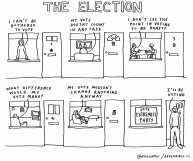
On 22 May UK citizens will determine who will represent them in the European Parliament until 2019. Recent turnout in these elections has been low (only a third of those entitled to do so voted in the 2009 European election, compared to two thirds in the 2010 General Election). But one in ten of all Members of the European Parliament represent the UK, and the chance to elect them comes for us only once every five years. Abstaining is the worst option.
So what's it all for? The European Union (EU) was born among Europe's post-Second World War ruins. Its founders included influential Christian politicians who saw that the wholly independent national sovereign states in Europe had been tested beyond the point of destruction. They wanted to pool the sovereignty of these states in ways which would foster economic recovery and promote peace, not war. Values such as international cooperation, human rights and peaceful resolution of conflict were central to the original concept of the EU.
This concept of the EU makes more and more sense in an age of increasing globalisation. Economic and political power has long since ebbed away from Europe towards the USA but and other emerging giants as China. Individual European countries don't have a great deal of influence in world affairs, but collectively, it's a different story.
The UK's attitude towards Europe (partly down to the lingering dreams of empire and the idea of a 'special relationship' with the US) has always been ambivalent. This has meant a low turnout at Euro elections, and caused fringe, extremist, nationalist and even racist parties to get elected by default. The ultimate paradox is that the UK is represented by significant numbers of people whose main goal is withdrawal from the EU altogether. That alone ought to be sufficient motivation to vote.
The EU is certainly not perfect. It is technocratic, bureaucratic, its structures are widely perceived as remote, over-centralised and insufficiently accountable. But the answer to that is greater engagement, not withdrawal. The European Parliament has been steadily gaining power over recent decades and now acts as a co-legislator for nearly all EU law, adopts the EU budget and works with the national parliaments of EU countries.
In the UK, a small number of issues, mainly concerned with immigration (such as alleged 'benefit tourism'), are regularly but negatively and misleadingly highlighted as the main features of the 'European project', and even pictured as the only issues of concern to UK voters. Low UK turnout for European elections is caused partly by ignorance of the depth, breadth and richness of what is developing in Europe and the real issues at stake. Lots are things which Christians care about deeply. Things like climate change, growing inequality, security threats, population movements, crime, drug and human trafficking, are no respecters of national borders.
The details of how to address these things are of course the subject of debate, in which Christians, along with everyone else, will find themselves divided. But Christians have a duty to take part in the process; and that means at least to vote. Here's why:
First, Christians have a responsibility for all Creation. Christians should not idolise any human institution, but assess them all in terms of their capacity (however imperfectly) to bring true fullness of life to all humanity (and not just to small privileged sectors): the work for the 'common good'.
Second, specific values common to all Christians contribute positively to the development of society. As noted above, many of the areas central to the work of the EU are areas in which Christians are already engaged. Voting for representatives who will carry these ideals forward at the European level is a natural extension of everyday Christian witness.
Third, a central Christian virtue is hope, which should never be abandoned, even by default. Christians should always look for opportunities to 'go the extra mile' (Matthew 5:41).
A range of churches and church-related bodies are keen to get their message across to Christians and other believers about the forthcoming European Parliament elections and the need to vote. The Conference of European Churches, based in Geneva, Brussels and Strasbourg, speaks for a range of Protestant and Orthodox churches; COMECE is the Commission of the (Roman Catholic) Bishops' Conferences of the European Community; both have issued statements and guidelines recently; as have numerous other groupings such as the Joint Public Issues Team of the Baptist, Methodist and United Reformed Churches.
All these documents, and others, are available on the Faith in Europe website.
'Faith in Europe' is an ecumenical and interfaith body in association with Churches Together in Britain and Ireland. Our members include individuals and representatives of churches, other faith organisations and action groups of various kinds, other Europe-oriented bodies, academic and research organisations. We organise regular Briefing Meetings for our members on topics of current concern, and produce a regular newsletter with the texts of the presentations and discussions at our Briefing Meetings and other materials. We were delighted that recently a report on our latest Briefing Meeting in April was published inChristian Today.
There are two basic messages for Christians about the forthcoming elections to the European Parliament. First, turn out to vote: a big turnout means a more properly representative parliament. Second, vote according to your conscience; but make sure your conscience is properly informed about the huge range of issues at stake in the constantly evolving 'European project'.
Dr Philip Walters is the secretary of Faith in Europe. Find them on Facebook