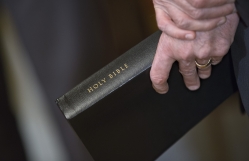
The Bible has been voted the most valuable book for humanity by the British public.
A survey by The Folio Society asked over 2,000 British adults to name the books of most significance for the modern world, and the Bible came out on top with 37 per cent of the vote.
Coming in at a close second was Darwin's On the Origin of Species, considered by many to be the foundation of evolutionary biology, at 35 per cent.
According to the research, those who chose the Bible did so because it "contains principles/guidelines to be a good person," while Darwin's work gained votes because it "answers fundamental questions of human existence".
Editorial director at The Folio Society, Tom Walker, said that the study may well indicate a better relationship between science and religion than has been in the past.
"The first question I had was whether the similar figure for Darwin and the Bible does show a continuing polarisation between the realms of science and religion, or whether in fact it reveals a more balanced approach to ideas for the modern reader," he explained.
"They are the two ideas which have clashed in the 20th century – this shows, I think, that we can take understanding from both of them."
Other books which made it into the top ten include A Brief History of Time by Stephen Hawking, Albert Einstein's Relativity: The Special and General Theory and George Orwell's dystopian novel Nineteen-Eighty-Four.
The Qur'an came in at number eight, which Walker attributed to "the impact of global debates around Islam".
He also said that the list may indicate those which are "perceived as having influence or giving understanding, rather than those which we personally read in order to understand the world around us."
"How different might the survey have looked 100, or even 30 years ago?" he added.
"How might it look in another 30 years – will Darwin have taken over; will the worrying rise of Nineteen Eighty-Four's relevance continue; might the Qur'an continue to rise in significance in the UK; or might advances in DNA technology mean that The Double Helix grows in stature?"
A survey undertaken earlier this year found that the Bible is also the most popular book in the US across all age groups and demographics.