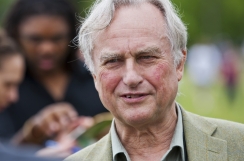
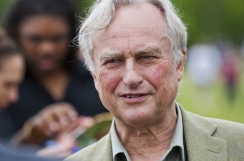
Want some good news? I was listening to some stats at a recent conference and we were told that of those who say there is no God, there are only very few – a "tiny percentage" – who actually come under the heading of angry, militant atheist.
There are, it seems, very few real Richard Dawkins clones. So, the speaker suggested, do not fret about the growth of militant atheism. Statistically, it just ain't happening.
Admittedly, those who do fall into the militant atheist bracket may make a lot of noise (just read the posts following articles on religion in our so-called quality newspapers), but demographically an awful lot of it comes from affluent, over-educated white middle-aged/elderly males residing in the leafier parts of north Oxford. To that extent, the speaker concluded, the old paradigm of the inevitable, progressive secularisation of western culture is just "not true". The secularisation theory is dead and buried.
Interestingly, quite a few of my fellow attenders did not greet the news of the death of this theory with outpourings of "hooray, the wicked witch is dead".
I find that intriguing and surprising. It's because an awful lot of Christian thinking since the mid-60s has been posited on the truth of the secularisation thesis – the idea that western culture was moving to a position where religion was not needed as a sacred canopy to guarantee society.
Secularisation theory was demoralising, because it gave us the impression that Christians were on the wrong side of history. The historical process was moving inevitably against us and it felt as though all we could be was a minority voice on the margins. At best we'd be tolerated, but there would be little point in evangelism when we were all doomed by the ineluctable historical process of secularisation.
It was paralysing. So, to hear that this theory was "discredited" by responsible sociologists ought to have cheered us all up, yes? But why then did some of us wonder whether this was to some extent false comfort?
Do not misunderstand me here. There are at least two reasons why I think it is good that even secular sociologists are – belatedly – falling out of love with the secularisation thesis. First, I think it was demoralising to feel on the wrong side of history, and demoralisation can paralyse our proclamation of the gospel. Second, I think as it was normally put, the theory was not true and never had been true, and acting on fallacious sociological theories is unlikely to advance the gospel, even if I have not been demoralised.
However, there are three things that should give us pause. First, what the theory was meant to explain was why organised religion, and Christianity in particular in the western context, was becoming more marginal. Put sharply, why are so few people in churches on Sunday mornings rather than playing sport, going to a shopping mall, having a weekend break or just having a lie-in? That sharp empirical fact was what, I think, stuck in the gullet of my fellow attenders. In an important sense, does it matter if someone is not a Richard Dawkins groupie when he or she still does not come to hear the Word of God and worship Him?
Second, we need to be clear that the problem with the secularisation theory was not just that it painted a false picture of the historical social process, but that it misconstrued what Christian theology and faith is trying to do.
Christian 'religion' is not about providing a sacred canopy under which members of society can have an integrated, cohesive set of social values which are appropriated and internalised by members of that society. Theologically it is about, as Paul puts it in 1 Thessalonians 1:9 and 10, turning in repentance from idols to serve the true and living God and awaiting his Son who has conquered death and delivers us from the wrath of final judgment.
This perspective of idols versus true and living God is vital. It is very clear that idols can provide a sacred canopy which functions to help the social construction of reality. That does not tell us whether it is a good canopy, or whether the reality that it helps construct is humane or cruel, good or bad, or – even more importantly – true. To that extent, I might even welcome secularisation if it helped eradicate a sacred canopy that acted as a guarantor of something like a caste system which saw some of my fellow men and women as 'untouchables'.
However, Christian theologians have long recognised that idols are not simply found in other religions: an idol is something that functions in Tertullian's classic words as "pro deo adversus deum" – "for God and against God" (On Idolatry). That word "pro", though, has a significant double edge. It can mean 'in place of' / 'substitute for', but can also mean 'in front of'. I find this double edge quite telling. An idol is a God-substitute in that it stands in place of God and can do so by standing in front of him – he is obscured by it. This helps me see that an idol need not be another 'god' like Zeus or Wotan, but anything that comes between me and the true God, usurping his proper place in my worship, blocking him out of my sight.
Put that way, of course, an apparently non-church, non-mosque, non-synagogue, or non-temple society can positively reek of idolatry, because there are all kinds of ways in which something can come between me and God and distract my attention onto it. Notably, wealth, reputation and self-glorification, the idols that Jesus sees at work among the Pharisees.
In that sense the secularised society is just another way of describing an idolatrous society. And that is the vice of the secularisation thesis: it distracted us from looking at our post-60s western culture as profoundly religious in an idolatrous sense. And the vice of simply rejoicing over the demise of the secularisation thesis is that it continues that distraction and does not take us to the key issues of whether we are idolatrous, what our idols are and how as Christians we can expose them as lies.
That takes me to my third observation. We are duty bound to expose idols wherever we find them as lies. There is only one true God and Jesus is his eternally begotten Son. But as soon as I say this I offend not merely Richard Dawkins (an admittedly far from disagreeable duty) but also all those people who are not 'militant atheists', but are deeply committed to a culture which regards religion much as it regards an extensive restaurant menu: some will like fish, some red meat and others lentil stew. But the choice is a matter of the individual taste of the consumer, and circumscribing that choice is seen as authoritarian and inconsistent with consumer sovereignty.
In fact, such authoritarian attitudes show, to a consumerist mindset, a kind of protectionism, in that consumer choices are artificially constrained by vested interests in favour of one product or brand rather than another. Blend that with the misgiving that religious protectionism is associated with violence and you have a very strong set of antipathies. To that extent, who cares if militant atheism is dead if what replaces it is a social attitude, backed by the relevant laws, that attempts to stop me saying that the difference between Christianity and idols is that Christianity is true? Oddly enough, the sociology stats didn't deal with that one.
Mike Ovey is the principal of Oak Hill College. This article is reproduced with permission from Commentary, Oak Hill's half-yearly magazine.