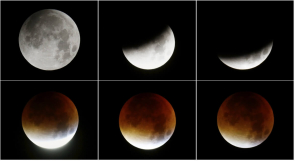
"What if this present were the world's last night?" mused the 17th century poet John Donne. According to Chris McCann of the eBible fellowship, he was out by 400 years: it's actually tonight. His prediction that the world will end on October 7 has been widely reported. "According to what the Bible is presenting it does appear that 7 October will be the day that God has spoken of: in which, the world will pass away," said McCann. "It'll be gone forever. Annihilated."
This is a disaster. I wanted to find out how Game of Thrones ends.
You and the rest of the world, but I don't think you need to worry too much.
Glad to hear it. But why does McCann think tonight's the night?
His reasoning runs to several thousand words which it would be tedious to go into in detail. There are copious biblical references, but it depends largely on speculation, assumption, fantasy and wishful thinking.
He isn't the first person to have tried this, is he?
Indeed not. Evangelist Harold Camping predicted it for May 21, 2011, then on October 21. John Hagee's Blood Moons theory belongs to the same sort of stable, though it doesn't involve predicting the end of the world. Protestant End-Times theorists look to particular interpretations of Daniel and Revelation to calculate scenarios for the end of the world, which can often be very complex and demonstrate highly creative thinking.
You don't sound very impressed.
Since Jesus specifically told people not to bother with that kind of thing, no. However, it's quite interesting that End-Times theorists tend to gain traction among Christians at times of great social upheaval. We have been living through such a time for the last few decades, and the vast improvements in communications technology we've seen have provided these speculators with a lot more material to draw on.
You say "tend to" gain traction – any historical examples?
In 1534-5, as the Reformation swept Europe and broke the monopoly of Catholicism in the West, the Anabaptist John of Leyden convinced people that they had to establish the Kingdom of God on earth in fulfilment of prophecy. He established a sort of commune in Munster in what's now Germany, abolishing private property and instituting polygamy. Munster was taken by Catholic forces in scenes of great brutality.
Any others?
Lots, but 17th century England is very fertile ground. The 'Fifth Monarchy' movment was very popular – the kingdoms of Babylon, Persia, Greece and Rome had passed away and the monarch of Christ was imminent. The scholar Christopher Hill writes: "Earnest men studied Daniel and Revelation, and identified the Little Horn of the Beast with whoever was their enemy of the moment."
Even James I thought that the contempt for clergy shown by most Englishmen was "a sign of the latter days drawing on". By the time the Civil War broke out (1642-1651), belief in an imminent return of Christ was commonplace. In 1643 the Parliamentary army was full of rumours that Christ would return to destroy King Charles; the role of John the Baptist would be played by the Earl of Essex. The vicar of Water Stratford, near Buckingham, believed that the 1,000-year reign of Christ would begin in 1694. On Easter Monday of that year he saw a vision of Christ sitting in a chair in his room, who told him that he would "appear in the air over Water Stratford and judge the world on Whitsunday following". Several other authorities fixed on a date in the 1690s. Thomas Beverley, rector of Lilley in Hertfordshire, predicted the end of the world for 1697; he wrote a book a year later proving that it had come to an end, but that no one had noticed.
The 18th century, on the other hand, was the Age of Reason. Hill concludes: "Henceforth millenarianism became a harmless hobby for cranky country parsons."
And now it's back?
Certainly in many evangelical churches, particularly in America, it's assumed that Revelation and Daniel do offer roadmaps for the end times and that current political and social developments match what they predict. Gay marriage, for instance, is sometimes taken as a sign of the end.
I think I'd have voted against gay marriage, if we'd had a vote.
Yes, but you shouldn't take your personal views and imagine that they're a fulfilment of biblical prophecy. You might, after all, be wrong. And the point is that, as Christopher Hill said, these speculators do identify the biblical bad guys with whoever their own enemy of the moment happens to be. So for instance Hal Lindsey in 1970 wrote a best-seller called The Late Great Planet Earth, in which he prophesied a Soviet invasion of Israel and said that the European Economic Community, as it was then, would be a revived Roman empire ruled by the Antichrist. He later predicted that the 1980s could be "the last decade of history as we know it".
I'm spotting a pattern here.
What these predictions have in common is that they are all wrong. Albert Einstein is said to have defined insanity as "doing the same thing over and over again and expecting different results", but humans are funny like that.
So why do we still fall for this stuff?
Speak for yourself. But I think there are two things going on. First, there is a genuine desire to preach the whole counsel of God in the Bible. But Revelation is a difficult book that needs to be really well taught before anyone should presume to preach on it. Second, there's a sense – again, particularly in the American evangelical world – that the world is changing, and not for the better. It's only natural that we should look to the Bible to find out what it says. But the world has changed before, and there have been far worse disasters in the past than anything anyone alive today has seen – in the 14th century the Black Death killed a fifth of the world's population.
How would you read Revelation, then?
That's a much longer post. Let's just say I don't think it has much to say about the future, but it has a lot to say about the present.
See you tomorrow, then.
You can count on it.
Follow @RevMarkWoods on Twitter.