Aid-dependent Nepal says needs $6.6 billion for post-quake rebuilding

Earthquake-battered Nepal will ask international donors to support a reconstruction plans that is expected to cost $6.6 billion over five years, the government said on Saturday.

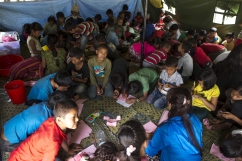
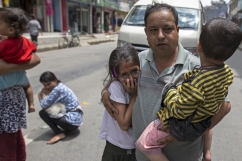
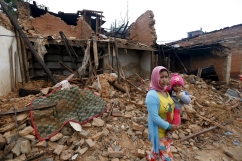
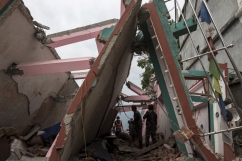
Two quakes on April 25 and May 12 killed 8,787 people and destroyed more than 500,000 homes, affecting 2.8 million of the Himalayan nation's 28 million people.

Losses to the economy from Nepal's worst disaster on record stand at $7 billion, including from tourism, the government said in a Post Disaster Needs Assessment (PDNA) report.

Suman Prasad Sharma, a senior finance ministry official, said 36 countries and 24 donor agencies had been invited to a conference on June 25 to pledge support for reconstruction.

"We have expectations of a very handsome and good support from our donors during the conference," Sharma said at a function in Kathmandu. Currently, Nepal gets two-thirds of the cost of its economic development in international aid.

Government officials said some donors who cannot pledge more aid could still help Nepal by writing off debt the country owes or delaying repayment schedules. Nepal does not have commercial borrowings from international lending agencies.

Concessional loans mainly from the World Bank and the Asian Development Bank account for 18 percent ofNepal's gross domestic product, according to the officials. The government spends $300 million in debt repayment every year.

Local donors say post-disaster reconstruction must be more accountable in a country that ranked 126 of 176 nations surveyed in Transparency International's corruption perception index in 2014, compared with 116 a year earlier.

Nepal's annual economic growth is expected to slow down to 3.04 percent, the lowest in eight years, from 4.6 percent estimated earlier, according to its statistics bureau, due to the impact of the earthquakes on tourism and infrastructure.

One in every four Nepalis lives on a daily income of less than $1.25.

The quakes have also set back Nepal's efforts to fight poverty by increasing the number of poor by 700,000 to 7.78 million, according to Govind Raj Pokharel, vice chairman of the National Planning Commission.

related articles
Sex traffickers prey on vulnerable Nepali girls in aftermath of earthquake

Sex traffickers prey on vulnerable Nepali girls in aftermath of earthquake

Death toll rises in second Nepal earthquake: \'The ground looked like it was rippling\'
Death toll rises in second Nepal earthquake: 'The ground looked like it was rippling'

Death toll rises in second Nepal earthquake: 'The ground looked like it was rippling'

Somebody collected Christian tweets about the Nepal earthquake and it makes for awkward reading...

Somebody collected Christian tweets about the Nepal earthquake and it makes for awkward reading...

Homeless Nepalis sleep in the open as monsoon rains approach

Homeless Nepalis sleep in the open as monsoon rains approach

News
Church of England directs £600,000 towards clergy mental health and financial support

The funding package includes new grants for two national charities working with clergy facing psychological strain and financial pressure.

St William shrine fragments return to York Minster after 500 years underground

Fragments of a long-lost medieval shrine honouring St William of York have returned to York Minster for the first time in nearly 500 years, marking a major moment in the cathedral’s history and a highlight of its programme for 2026.

New research sheds light on why women are more religious than men

Gender gaps were found to narrow in line with degrees of modernisation, secularisation, and gender equality. But, the paper finds, the "gap does not vanish entirely – even in highly secular countries women remain more religious than men".

Prince and Princess of Wales visit Lambeth Palace to meet new Archbishop of Canterbury

The Prince and Princess of Wales have paid an official visit to Lambeth Palace.