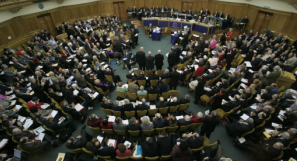
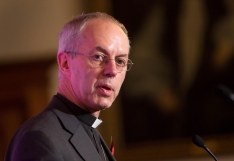
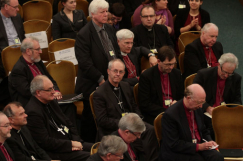
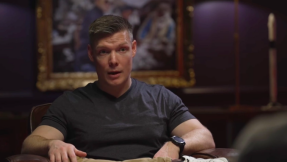
As the General Synod of the Church of England faces the vote on women bishops, its most important decision in recent decades, the Archbishop of Canterbury's head of reconciliation has outlined the keystones of his path to peace.
Canon David Porter, who has been working for month behind the scenes in the Church of England to broker new relationships between the factions divided over the consecration of women, told an international audience of church leaders that bad religion too easily triumphs over good, and that reconciliation is elusive.
Canon Porter, a leading peacemaker behind the scenes during the Troubles in Northern Ireland, made six "pertinent and provocative" observations of his experience of being a "religious peacemaker" in a situation of conflict where religion has often been said to be the cause and part of the problem rather than the solution.
He was speaking at the annual lecture of the Awareness Foundation, a charity working to empower Christians to be a counter force of love and peace, at St George's Bloomsbury in London, along with the foundation's director, the Rev Nadim Nassar, who spoke about Syria and the Middle East.
Canon Porter said he had no expertise on the Middle East and he also did not refer to women bishops. However, there is no doubt that in church circles, his work has brought about a tentative new mood of hope that the legislation will succeed when the Synod votes on Monday 14 July at its meeting at York University.
"I do speak out of the situation in Northern Ireland," he said. "I was 10 years old when the current phase of our conflict erupted, in 1968. The early days of the Troubles and the extreme violence of that period overshadowed my teenage years and very much shaped my own Christian faith and discipleship. How do we live out our faiths, bearing witness to the Prince of Peace, in a community where in the name of our religion we find it difficult to like each other? In fact, where it was all too easy to nurture hate."
He became involved in a number of initiatives, trying to respond to the conflict in Northern Ireland from a position of Christian faith, firstly by challenging his old faith community, evangelicals, about their response to the conflict, which he said was "not always helpful". This included challenging the narrative presented by Ian Paisley. "It was out of that challenge to our own community to live out the values of peacemakers and reconcilers that I personally got involved in behind-the-scenes relationships and connections, both with those in the Republican movement in Northern Ireland, the IRA and Sinn Fein, and those in loyalist para-militarism."
Firstly, he said, "It's always political. Always. It is too easy and too lazy to blame religion for the problems of our world." Most conflicts are complex, and are what peace scientists call "identity conflicts". They involve political, economic, ideological, social, cultural and many other issues.
Certainly in Ireland, the 17th century religious conflict shaped and set the context for those issues. But the Irish conflict actually began in 1172, before there were Catholics and Protestants, and was about Norman invasion of Celtic land.
"It was profoundly political. And the conflict in Ireland has been going on for 900 years of which the last 40 years up to finally achieving the peace agreement in 1998 "was only the latest manifestation" of what was at its heart a political problem. "To reduce it to religion is lazy and to miss the point."
But what is true to say is that the religious faiths of many did become the wellspring for individuals to work towards peace and find a way out of the conflict.
Secondly, "Bad religion always trumps good."
Demonising the other because they are not "part of us", the belief that others are wrong and therefore have no rights, is a very "European religious war concept". He confessed he was not actually an Anglican, even though he works for the Archbishop of Canterbury, but is non-conformist, brought up an Irish Presbyterian. His people suffered under the laws in Ireland as well as the Catholics, because the law was used to impose Anglicanism upon them.
"So religion in that sloganeering political context has been used over the centuries to make other people in the wrong, to make them the other, to demonise them, to exclude them. And that sort of bad religion is very easy to sell. It comes in soundbites, it comes in slogans. It comes in statements that raise the blood."
It was hard for religious leaders to convey a different message of reaching out and understanding in the heat of conflict. "In that context, bad religion triumphs. That is why the task of all of us is to make sure that good religion gets embedded into the community as a long-term project of transformation."
Thirdly, "We are all responsible. Most people in Northern Ireland did not participate in the violence and it is true that most people who carried out the violence didn't go to church on a Sunday. But the reality is that all of us, while we may not have pulled triggers we did point our voice."
People who grow up in divided societies are all complicit in the damage of the conflict: "We may not be particularly culpable for the acts of violence but we are complicit. Therefore we have a responsibility to own our parts in making the problem before we contribute to the solution."
Fourthly, "History matters. We are reminded rather dramatically at the moment that the history in the Middle East and within Islam goes back centuries is also a factor that needs to be born in mind to understand the conflicts going on. The Western world has historical amnesia. We like to think that what happens in the past is done and dusted and we move on into the future."
Our part in history, our colonial past, had exacerbated and contributed to many of the problems we face in the world today. We need to take the past seriously, and too few do, thinking it not necessary to remember what happened in the 17th and 18th centuries in Ireland, for example. Yet it does, because through stories passed down through the generations, the hurt, the grievance, the wounds are remembered.
Fifth, "Peace offends. We all think peace is a wonderful thing. But let me tell you, enemies becoming friends looks and feels ugly and offensive."
Finally, "Reconciliation is elusive. As a director of reconciliation I often like to introduce talks by saying, I don't believe in reconciliation."
There is no such thing as somehow, suddenly entering an ideal state where everyone gets on, he concludes: "Reconciliation is a journey.It is a journey whose destiny as peoples of faith in one sense lies beyond us. It is a gift of God."