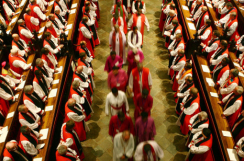
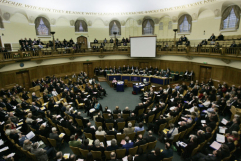
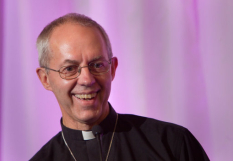
It won't be long now before the Church of England will be faced (again) with the question that has dogged and bedeviled it for the last quarter of a century. Having ordained women to the priesthood in 1994 after a fiercely-fought campaign by traditionalists determined to keep them out, when would it nerve itself for the next logical step, the consecration of bishops? Longer than might have been thought on that glad, confident morning, but the July Synod looks set to do it. Conservative evangelicals and Anglo-Catholics will hold their noses, but the smooth operators of the C of E curia and the fear of another storm of public derision will probably see the deed done.
Coincidentally, this Saturday the Methodist Church will celebrate 40 years since the ordination of women, in 1974. Methodists in the UK don't have bishops, but there are plenty of District Chairs, their nearest equivalent. Baptists were way ahead of either, in 1922 – and have recently appointed their first female general secretary – though the Congregationalists were just ahead, in 1917.
If you are one of the vast majority who thinks it a little odd, to put it no more strongly than that, to retain a qualification for ministry based purely on anatomy, you might think, "A good job done." However, you'd be wrong. While female Methodist ministers number around 40 per cent and the Salvation Army just under 50 per cent, Baptists are only around 10 per cent; only one of its 13 regional Associations is headed by a woman. And Anglicans? There it gets interestingly complicated. According to statistics published on the Church of England's website, there has been a sharp rise in the number of ordained women. Between 2002 and 2012 the number of full-time female clergy rose to 1,781, against the number of full-time males which dropped to 6,017. That's nearly a quarter, and good progress, it might be argued, in a short time.
However: there are consistently more women ordained as non-stipendiary ministers (NSMs), meaning that they earn their living outside the Church. In 2012, 162 males were ordained to stipendiary ministry and only 94 women. So the vast majority of vicars and rectors in their own parishes are, and will continue to be, male; and as long as substantial pastoral experience is held to be a qualification for senior office (and surely it should be) the pool from which women bishops can be drawn is going to be proportionately smaller. There is, too, a very noteworthy different between dioceses: the Hereford diocese comes bottom of the discrimination league, with 47 per cent women clergy (68, with 76 male) while the mighty London diocese is second to the top, with only 140 women to 553 men. Only Chichester is worse.
These are substantial denominations, but they obviously don't represent the whole of the UK Christian spectrum. So another figure to throw in to the pot is this: according to a UK Church Statistics survey from 2012, female ministers represented seven per cent of all clergy in 1992, but rose to 18 per cent by 2010. The figures aren't broken down further, but the trend is clearly upwards.
So, what does this blizzard of statistics have to tell us? There are all sorts of reasons why there might be fewer female than male ministers even in a denomination that claims to welcome them, and not all of them are entirely unworthy. You would have to be pretty fundamentalist on gender issues not to recognise that childcare, for instance, is often going to be more of a factor for women than for men, making the NSM route more attractive. Perhaps, in this respect at least – and this is speculation – one reason for the relative success of Methodists is that their ministers are older; only 18 out of 2,000, of either gender, are under aged 30. Methodists, however, have another advantage, in their system of government. When their Conference says a thing is to be so, it is so. Once having agreed to ordain women, the deal was done and congregations had very limited wiggle room. In the case of Baptists and Anglicans, however, it is quite different. A Baptist Association can commend a woman and a college can train her, but she is not ordained until a congregation calls her; and this is where all sorts of subtle games can be played. An intransigent deacon can ensure that a name is discreetly dropped off a list of candidates sent for consideration; the feelings of so-and-so who "just wouldn't feel comfortable" are given undue weight; "perhaps this just isn't the time" is the conclusion. In the case of the Church of England, both the congregation and the bishop play a part; there are innumerable ways in which the path to ordination can be strewn either with roses or with thorns.
Has any denomination got it right? Probably not, but some are doing better than others. Of course, there are plenty of churches which don't believe in women ministers on principle. May the Lord bless and enlighten you; however, for those who do, but are struggling with the practice, isn't it time to bring the ministry of women out of the shadows and let your churches receive all that they might be called to offer?