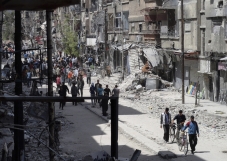
The situation in Palestinian refugee camp Yarmouk has "slumped to even lower levels of inhumanity" since the infiltration of Islamic State militants last week, a UN official has told Christian Today.
"[The camp, in Damascus, Syria] was frankly a hell hole even before the events of the last week," said spokesman Chris Gunness, of the UN Relief and Works Agency for Palestine Refugees in the Near East (UNRWA).
"What we're seeing is intense fighting, unconfirmed reports of aerial bombing, people cowering in their baths at home, too frightened to leave to get food, or water or to get help. There are inconceivable levels of inhumanity."
The UN Council has demanded access to Yarmouk after having been unable to enter it for the past week. A monitoring group first reported on April 1 that ISIS had taken over large parts of the camp, and witnesses said it had joined forces with the al-Qaeda linked al-Nusra Front which already controlled much of it. A source who needed to remain anonymous for security reasons told Christian Today that the two are understood to be working together, and 60 per cent of the camp has been taken over by the combined groups. That area contains 95 per cent of the residents, including 3,500 children. The source said there was no resistance to ISIS from Nusra, and so the militants were able to move very quickly through the camp.
Once home to around 150,000 refugees, and now with around 18,000 Palestinian residents, Yarmouk has been caught between government forces and Syrian insurgent groups since 2012 but until now has not been infiltrated by ISIS. Sometimes known as the southern gateway to Damascus, it is considered to be in a strategic position; whoever controls Yarmouk, controls access into Damascus from the South.
Beyond the possible political repercussions, the immediate need is humanitarian. In a press briefing on Monday, Commissioner-General at the UN Relief and Works Agency for Palestine Refugees in the Near East (UNRWA), Pierre Krähenbühl, said that the situation is now "more desperate than ever".
"Right now, what is on the mind of people at Yarmouk is bare survival," he said. Having recently visited the camp in person, Krähenbühl recalled: "I just saw people waking up with so much despair in their eyes, waiting for their meagre assistance."
It is "one of the most severe [situations] ever," he added.
Jordanian ambassador to the UN and currently the president of the Security Council, Dina Kawar, said it was calling for "the protection of civilians in the camp for ensuring humanitarian access to the area, including by providing life saving assistance and ensure safe passage and evacuation of the civilians".
Food, medicine and water are scarce in the camp, and civilians rely heavily on aid supplies. According to the UNRWA, it was only able to deliver food to refugees on 131 days of 2014, averaging 89 boxes per day over the year. To meet the minimum needs of those living there, it needs to distribute at least 400 boxes every day.
"We are facing the potential slaughter of innocents, there are 3,500 children are trapped in this camp and street fighting is raging," Gunness said.
"We have had no access at all since a week ago...[Residents have no access to] UN water, UN food or UN medicine, so you can draw your own conclusions from that. These are desperate people."
There is some hope, however. Gunness confirmed that 94 civilians, including 43 women and 20 children, were able to leave the camp on Sunday and received humanitarian support. The details of their departure aren't clear, but Gunness said it means it's possible that more people will be able to escape.
"If 94 people were able to leave the camp, we can have 194 people leaving. And if we can have 194 people leaving, we can have an awful lot more. Let's build on that," he said.
"We need a pause, and we need humanitarian access...If people want to leave, there has to be evacuations in accordance within international humanitarian law."
Speaking to Deutsche Welle, Gunness described Yarmouk as a "hell hole" even before the ISIS infiltration. He said "meaningful diplomatic and political pressure" is now vital to bring the siege to an end.
"We need concerted political action," he added. "Those powers know who they are and they know what they have to do."