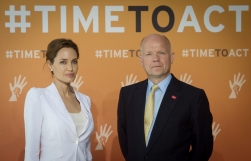
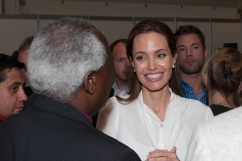
You've got to feel for William Hague. There he was, on Tuesday 10 June, at the first day of the biggest ever international meeting about rape in war, with an already packed schedule, when it suddenly starts kicking off in Iraq.
As reports and pictures of the carnage and terror in the Middle East started coming through, he was hauled over the coals by many commentators for not saying what they wanted him to about intervention.
It's the nature of any Cabinet Minister's job that important long-planned developments can be overtaken by an urgent and unexpected problem. For the Foreign and Commonwealth Office in particular, it must often feel as though there's no point setting an agenda because events will always overtake the best laid plans.
But, to give him his due, on sexual violence Hague has put in the work over a number of years to get us to this point. Despite being a white middle-aged man.
In fact, it's been immensely helpful to have a bloke take up the challenge. He's done a good job of avoiding putting his foot in it in the way that well-meaning people often do when talking about something they haven't experienced. And there must have been plenty of opportunities for him to do so, given the wide range of religious, political and feminist ideologies represented in the conversation.
Helpful because, with the best will in the world, sexual violence is still often seen as a 'women's thing' and female political leaders are often expected to pick it up, arguably so the chaps can get on with the real work. Hague's leadership has stated clearly that this IS the real work, and that it's something everyone should care about; not just the girls.
He's done that in a couple of important ways. The main thing, for which many people commended him at the recent summit, is that he has listened to survivors.
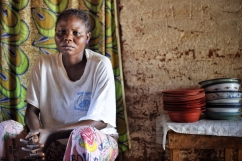
From my experience of interviewing rape survivors in Central African Republic, Rwanda and other current or former war zones, women often feel unheard and forgotten. They plead for people to hear their story and to acknowledge that this terrible thing has happened to them. They will often talk of feeling ignored by men; either because their partners have rejected them as a direct result of the rape, or because the men in their community are uncomfortable or embarrassed and don't want to talk to them.
Hague has met with many of these women and has sat with them and listened to them. Women who have felt forgotten by the world have met with someone who has taken them seriously and has promised to try to change things. And, for many of them, it's the first time any man has done that, let alone someone with political and diplomatic power.
The second thing is that he made the point, early on, that actually it isn't only women who are raped and abused. A couple of years ago, when he announced that ending sexual violence in conflict was to become one of his priorities, he deliberately pointed out that men were being raped in many conflicts, referring to the Syria crisis in particular.
But despite all that, there's been a fairly heated debate about what Hague has achieved and whether the Ending Sexual Violence in Conflict summit was a distraction from the real business of foreign policy.
From our point of view at Tearfund, the summit achieved some pretty crucial things. The obvious one is that it named rape as a weapon of war and made an important statement that the world is not prepared to tolerate it any more.
But, beyond raising awareness, it also produced an international protocol which now helps us to define, report and investigate sexual violence in conflict. More than a bit of paper, this takes us a huge step forward in making sure people are believed and that they find redress.
The difficulties of reporting rape in any country, and the awfulness that so many people wade through in trying to find justice, is old news - although, sadly, not yet confined to history. Imagine how much harder it is to be believed, helped and advocated for when you're living in a war zone. An international protocol is not as boring as it sounds.
And the other thing that makes my heart sing is that we were able to make sure the Church was recognised as one of the most important places for people affected by sexual violence. In many countries, the Church is the first port of call for people going through trauma and is also immensely influential in forming and changing attitudes and behaviour.
The Archbishops and denominational leaders who joined Tearfund at the summit, travelling here from Democratic Republic of Congo, Rwanda, Burundi and Central African Republic, among other places, have gone home with a renewed sense of calling. As do many people of influence, they have lots of competing demands for their time and attention, and just can't address all the needs in front of them. This summit, with its recognition of the importance of faith and its searing honesty in describing the realities of the trauma - family breakdown, economic poverty, physical injury, emotional anguish - caused by sexual violence, has given them impetus to go back and lead their countries to take this seriously.
In the short term at least, Hague will probably be judged on last year's Syria vote and his response to Iraq and the Middle East. But history should note that, whatever his responses to immediate crises, he has chosen to battle the hidden crises and causes of violent conflict. The moral dimension of his brief may be forgotten for a while, but it extended to more than the sexual violence issue. An early speech was a passionate call for action on climate change. Let's hope he will continue to make that case at the Cabinet table.
Because of course, there's more to foreign policy than war. And, while international development is often seen as a separate thing, especially since DFID was formed to take on the brief, there's a lot that comes in to the FCO brief that affects the world's poorest people. Policies on trade, security and economic development may not be the sexiest in the world but make a huge difference to whether emerging economies can grow in a way that helps everyone to prosper and leaves no-one behind.
As Foreign Secretary, he has recognised that a rounded and compassionate foreign policy acknowledges the causes and realities of war, making sure that the rules of war are kept and civilians are protected. That doesn't seem like a distraction to me.
Katie Harrison is Tearfund's head of communications.