[Reader warning... graphic description]
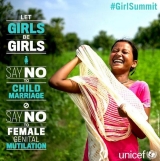
The government is co-hosting the Girl Summit today with UNICEF, in an attempt to tackle Female Genital Mutilation worldwide.
More than 125 million women in Africa and the Middle East have suffered from FGM, where the practice predominates.
But as many as 137,000 women in the UK are thought to have been cut, and a further 66,000 girls and women in Britain are currently at risk.
One of the main goals for dealing with this issue in Britain is to increase public awareness and education so that people can identify and support girls who may be at risk.
So how can you tell if a girl may be at risk of FGM? What are the signs, and where can they go for help?
What is it?
FGM includes procedures that intentionally alter or injure the female genital organs for non-medical reasons. It is usually performed on girls before the age of 15, most commonly between the age of five and eight.
There are different forms of mutilation, including removing the clitoris and labia minora, and in some cases removing the labia majora. Other practices include narrowing the vaginal opening, piercing, scraping or cauterising the genital area.
After it has been done girls may experience shock, bleeding and infection. It can later result in problems urinating, some women are made incontinent, and cysts and genital sores can develop. Infertility and complications in childbirth, including an increased risk of new-born deaths are other possible outcomes.
Some women face repeated surgeries, as they can be cut to allow for sexual intercourse and childbirth, which of course increases the risk of harmful effects.
It's usually performed without anaesthetic or antiseptic, using any sharp implement – knives, scissors, even glass. It is most often done by traditional circumcisers, who have a particular role in community life, such as attending childbirths. However, the World Health Organisation reports an increasing medicalization of the practice.
Why is it done?
There are no health benefits to FGM. It's often suggested that religious leaders promoting the practice, though religious leaders have varying views, and it is done in Christian and Muslim communities as well as those practising traditional, tribal religions.
It is often tied to an understanding of appropriate sexual behaviour within a community. It is held up as an ideal for premarital virginity, and can be seen as beautiful or modest, as well as being perceived as 'clean'.
In many communities FGM is believed to reduce a woman's libido and therefore thought to help her resist illicit acts, or make women fear the pain involved in sexual intercourse, and similarly prevent illicit relationships.
It is propagated as a cultural tradition. Where it is expected that a bride will have had it done, a young woman who hasn't been cut can be seen as undesirable. It becomes something that girls want to have done and their mothers can also be reluctant to prevent it.
What are the signs?
The summer holidays are known as the 'cutting season'. Girls are taken out of the UK for the summer in the hope that they will heal before the new school term.
In the UK, girls from Somali, Kenyan, Sudanese, Sierra Leonean, Egyptian, Nigerian, Eritrean, Yemeni, Kurdish and Indonesian communities are most at risk.
According to the NSPCC, a girl or woman may:
- have difficulty walking, sitting or standing
- spend longer than normal in the bathroom
- have unusual behaviour after an absence from school
- be particularly reluctant to undergo normal medical examinations
- ask for help, but may not be explicit about the problem, owing to fear or embarrassment
Where can girls get help?
If you are worried a child is at risk of, or is a victim of FGM, contact the NSPCC FGM helpline anonymously on 0880 028 3550 or fgmhelp@nscpcc.org.uk
FGM was made illegal in the UK in 1985. From April this year health professionals began logging information about FGM injuries and patients with a family history of FGM.