Barack Obama has addressed tens of thousands of Protestant Christians in Germany, defending his liberal record and saying: 'In this new world we live in, we can't isolate ourselves – we can't hide behind a wall.'
The former US president was speaking today alongside German Chancellor Angela Merkel in front of a massive crowd of up to 140,000 which gave him rapturous applause at the biennial congress of the German Protestant Church.
Obama and Merkel discussed democracy and faith a few yards away from where the Berlin Wall wound around the Brandenburg Gate as it divided the city between 1961 and 1989.
The gathering sees some 2,500 events with 30,000 contributors and guests from all over the world celebrating the 500<sup>th anniversary of the Reformation and the Protestant culture of debate.
Yesterday evening, more than 100,000 worshippers attended three open-air services marked the start of the 'Kirchentag' gathering of the German Protestant Church Assembly, which has been held every two years since 1949.
It was founded by the East Prussian politician Reinold von Thadden, a member of the Confessing Church, which opposed the Nazi regime; Von Thadden was in the resistance during the Nazi era before acting as the president of the Kirchentag until 1964.
Obama was the centre-piece of the event. He spoke on a range of policy issues, including refugees. Warning against xenophobia, he said: 'In the eyes of God, a child on the other side of the border is no less worthy of love and compassion than my own child. You can't distinguish between them in terms of their worth or inherent dignity...We can't isolate ourselves – we can't hide behind a wall.'
He added that 'we have to push back against those trends that would violate human rights or that would suppress democracy'.
The former president raised healthcare as the achievement of which he is most proud, saying: 'My hope was that I was able to get 100 per cent of people health care while I was president. We didn't quite achieve that, but we were able to get 20 million people health care who didn't have health care...Certainly, I have some regrets...Obviously some of the progress that we made is now in peril ... but the point really is for those 20 million people, their lives have been better. We have set a standard that people can build on.'
Merkel said: 'We will only be able to live in a good and peaceful society if everyone is doing well. That is what we mean when we say inclusive growth and we have to understand this and invest in this.'
Obama concurred, saying: 'One of the major questions that this generation and future generations will have to face s the growing gap in opportunity and increasingly inequality that we are seeing between nations and within nations.'
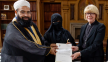
Those attending the event included the Archbishop of Cape Town Thabo Makgoba, the Grand Imam of Cairo's Al-Azhar Mosque, Sheik Ahmed el-Tayyib, the philanthropist Melinda Gates, the German singer and songwriter Max Giesinger and the Israeli author Amos Oz.