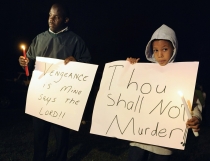
Americans campaigning against the death penalty have received a boost with the release yesterday of a resolution from the influential National Association of Evangelicals which backs away from its previous strong support for capital punishment.
Approved on October 15, the resolution says: "Evangelical Christians differ in their beliefs about capital punishment, often citing strong biblical and theological reasons either for the just character of the death penalty in extreme cases or for the sacredness of all life, including the lives of those who perpetrate serious crimes and yet have the potential for repentance and reformation. We affirm the conscientious commitment of both streams of Christian ethical thought."
While the new line does not call for a ban or moratorium on executions, it is being hailed as progressive in that it acknowledges the strength of the case against capital punishment.
The NEA's previous standing resolution, adopted in 1973, regrets the decline in executions and calls for legislation to make it mandatory for crimes including hijacking and kidnapping which results in physical harm.
Founded in 1942, the NAE represents more than 45,000 churches from almost 40 different denominations. Evangelical support for the death penalty has been falling in recent years, from 76 per cent in 2011 to only 59 per cent in 2014 – the latter figure nearly in line with national opinion.
While the new statement stops short of calling for an end to capital punishment, disappointing some campaigners, it is explicit about the failings in the system. It identifies "eyewitness error, coerced confessions, prosecutorial misconduct, racial disparities, incompetent counsel, inadequate instruction to juries, judges who override juries that do not vote for the death penalty, and improper sentencing of those who lack the mental capacity to understand their crime".
It also refers to the number of wrongful convictions overturned due to DNA evidence, saying: "Despite differing views on capital punishment, evangelicals are united in calling for reform to our criminal justice system."
While the statement says that evangelicals believe that "moral revulsion or distaste for the death penalty is not a sufficient reason to oppose it", it acknowledges the strength of the case for opposition. Referring to the standard set by the Mosaic law, it says: "The contemporary American system is unlikely to reach such standards of evidence, and given the utter seriousness of capital crimes, the alarming frequency of post-conviction exonerations leads to calls for radical reform."
Commentators have pointed out the irony of the historical strength of evangelical support for the death penalty in the light of evangelicals' pro-life commitment in the case of abortion.
During his US visit, Pope Francis called for a ban on the death penalty worldwide and specifically urged US authorities to stop the execution of Kelly Gissendaner, condemned for conspiring to murder her husband. Gissendaner was executed on September 30.