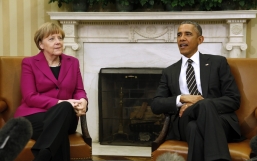
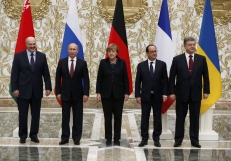
Germany, France, Russia and Ukraine agreed to a deal offering a "glimmer of hope" for an end to conflict in eastern Ukraine, but the United States and NATO said further intense fighting on Thursday ran counter to the spirit of the accord.
The agreement, announced after more than 16 hours of discussions in the Belarussian capital Minsk, was followed swiftly by allegations from Kiev of a new, mass influx of Russian armour into rebel-held eastern Ukraine.
It calls for a ceasefire between Ukrainian forces and Russian-backed separatists starting on Sunday, the withdrawal of heavy weapons from the front line and constitutional reform to give eastern Ukraine more autonomy.
Fighting has intensified in recent days as the rebels try to take control of Debaltseve, a strategic transport hub that would link the two separatist-controlled areas of eastern Ukraine, where elections are contemplated under the accord.
The White House, under pressure from Congress to provide arms to the stretched Ukrainian military, said the deal was "potentially significant" but urged Russia to withdraw soldiers and equipment, and give Ukraine back control over its border.
"The United States is particularly concerned about the escalation of fighting today, which is inconsistent with the spirit of the accord," it said in a statement.
NATO Secretary General Jens Stoltenberg echoed that line and told Norwegian news agency NTB: "Russia must end its support for the separatists and withdraw its forces and military equipment from eastern Ukraine."
Russia denies arming the rebels and sending troops to fight alongside them, despite what Ukraine and its Western allies say is overwhelming evidence. The conflict has killed more than 5,000 people since last April.
Keeping up the pressure on Russia, diplomats said the European Union would go ahead on Monday with a new round of sanctions against 19 Ukrainian separatists and Russians, regardless of the new ceasefire.
The asset freezes and travel bans, the latest in a long series of sanctions by the EU and United States, have piled intense economic pressure on Russia's energy-exporting economy, which has also been hit by a halving of world oil prices since last June.
After an EU summit in Brussels, the leaders of Germany, France and the European Council said wider sanctions were possible if Russia violated the ceasefire agreement.
US officials also said they were not taking sanctions off the table and bluntly warned the separatists against seizing more land before Sunday's ceasefire formally takes effect.
"We are trying to send the message as strongly as we can that any effort to grab more land between now and Saturday night ... will seriously undercut this agreement," a senior US official who spoke on condition of anonymity told reporters in Washington.
"TOUGH AND EMOTIONAL"
The Minsk talks were the culmination of a dramatic initiative by France and Germany following an upsurge in fighting in which the separatists tore through an earlier ceasefire line agreed to last September.
Russian President Vladimir Putin accused Ukraine of prolonging the negotiations, which seemed close to failure at several points.
German Chancellor Angela Merkel said Ukraine President Petro Poroshenko "did everything to achieve the possibility of an end to the bloodshed". She said Putin put pressure on the rebels to agree to the truce "towards the end" of the talks.
"This is a glimmer of hope, no more no less," Merkel told reporters on arriving, straight from the talks in Minsk, at a European Union summit in Brussels. "It is very important that words are followed by actions."
Russia's RIA news agency quoted Kremlin spokesman Dmitry Peskov as saying the talks were "tough and very emotional".
The accord could delay the imposition of new sanctions against Moscow, although the US State Department said it had not taken any options off the table. Secretary of State John Kerry said sanctions could be eased if it were implemented.
Fighting has surged in the past few weeks with more than 70 Ukrainian servicemen and at least 24 civilians killed so far this month, according to Reuters calculations based on official Ukrainian figures.
A Ukrainian military spokesman said about 50 tanks, 40 missile systems and 40 armoured vehicles had crossed overnight into eastern Ukraine from Russia. It was not immediately possible to verify the figures, which were higher than in previous such statements. Moscow dismisses them as groundless.
NATO has said there is overwhelming evidence of Russian armour entering Ukraine but declined to comment on the latest report.
"The intensity of fighting is evidenced by a sharp increase in the number of people trying to leave front-line towns," spokesman Andriy Lysenko said in a daily briefing held on Thursday before the deal was announced.
Rebel fighters accuse Kiev of shelling civilian areas, an accusation the Ukrainian military rejects.
The fighting has destabilised Ukraine militarily and economically. As the deal was reached, Ukraine was offered a $40 billion lifeline by the International Monetary Fund to stave off financial collapse.
Russia's economy has also suffered, from the sanctions imposed for its support for the separatists in eastern Ukraine and annexation of Ukraine's Crimea region last year. Russian shares surged on Thursday after the deal was announced and the rouble gained but then slipped back.
WEAPONS WITHDRAWAL
The agreement addressed some of the main stumbling points, including a "demarcation line" between separatists and Ukrainian forces, which the rebels wanted to reflect gains from a recent offensive that shredded an earlier ceasefire deal.
The compromise was that the rebels will withdraw weapons from a line set by the earlier Minsk agreement in September, while the Ukrainians will withdraw from the current front line, creating a 50 km (30 mile)-wide buffer zone.
Ukraine will also get control of its border with Russia, but in consultation with the rebels and only after the regions gain more autonomy under constitutional reform by the end of 2015.
Kiev has made clear, however, that it will not accept independence for the "People's Republics" the rebels have declared.
The ceasefire and heavy weapons pullback would be overseen by the Organization for Security and Cooperation in Europe, a Europe-wide security body.
French President Francois Hollande, who also took part in the negotiations, said there was still much work to be done on the Ukraine crisis, but the agreement was a real chance to improve the situation. "The coming hours will be decisive," he said later in Brussels.
Pro-Moscow separatists tightened the pressure on Kiev by launching some of the war's worst fighting on Wednesday, killing 19 Ukrainian soldiers in assaults near the railway town of Debaltseve.
On Thursday, senior rebel commander Eduard Basurin said his side would deliver on the ceasefire but that in the meantime Ukrainian troops should surrender Debaltseve. He said the separatists were holding "counter-attack" operations to prevent the soldiers from breaking out.
As the fighting has escalated, Washington has begun openly talking of arming Ukraine to defend itself from "Russian aggression," raising the prospect of a proxy war between one-time Cold War foes.
As the French and German leaders' peace initiative was announced, pro-Russian rebels appeared determined to drive home their advantage ahead of a deal. Armoured columns of Russian-speaking soldiers with no insignia have been advancing for days around Debaltseve, where heavy fighting has occurred this month.