MPs today passed legislation making Britain the first country to allow a "three-parent" IVF technique.
In an historic vote held in the House of Commons, 382 were in favour and 128 against the technique which doctors say will prevent some inherited incurable diseases. Critics, however, contend it signifies a step towards creating designer babies.
Public Health Minister Jane Ellison said that the decision would be "a bold step for parliament to take, but it is a considered and informed step."
"This is world leading science within a highly respected regulatory regime," she said, adding that for many families it would be a "light at the end of a very dark tunnel."
However, Christian MP Fiona Bruce expressed her concerns about the technique. "[This] will be passed down generations, the implications of this simply cannot be predicted," she said during the debate.
"But one thing is for sure, once this alteration has taken place, as someone has said, once the gene is out of the bottle, once these procedures that we're asked to authorise today go ahead, there will be no going back for society."
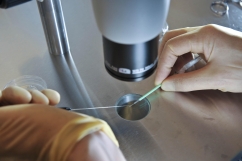
The technique is called mitochondrial donation, and the treatment is known as "three-parent" in vitro fertilisation (IVF) because the babies -- born from genetically modified embryos -- would have genes from a mother, a father and from a female donor.
It is designed to help families with mitochondrial diseases, incurable conditions passed down the maternal line that affect around one in 6,500 children worldwide.
The process involves intervening in the fertilisation process to remove mitochondria, which act as tiny energy-generating batteries inside cells, and which, if faulty, can cause inherited conditions such as fatal heart problems, liver failure, brain disorders, blindness and muscular dystrophy.
International charities and advocacy groups urged Britain to pass laws to allow the treatments, saying Tuesday's vote offers a "first glimmer of hope" of having a baby that can live without suffering.
In an open letter to lawmakers, the US-based United Mitochondrial Disease Foundation, the Australian Mitochondrial Disease Foundation, as well as other groups from France, Germany, Britain and Spain, described mitochondrial disease as "unimaginably cruel".
"It strips our children of the skills they have learned, inflicts pain that cannot be managed and tires their organs one by one until their little bodies cannot go on any more," they wrote.
Critics say the technique will lead to the creation of genetically modified "designer babies".
Members of parliament were given a free vote on the proposed new laws after the debate today.
Lawmaker Jacob Rees-Mogg said he would vote against.
"At the moment there is a very clear boundary that babies cannot be genetically altered, and once you've decided that they can, even for a small number of genes, you have done something very profound and then it's merely a matter of degree as to what you do next," he told BBC radio.
David King, director of a pro-choice campaign group, Human Genetics Alert, urged others to follow Rees-Mogg's example.
This was "about protecting children from the severe health risks of these unnecessary techniques and protecting everyone from the eugenic designer baby future that will follow from this," he said.
A second vote is required in the House of Lords before the technique can be legally used. If it passes, then the first 'three-parent baby' could be born in 2016.