Proposals to make the UK the first country in the world to allow three-parent babies to be born have been strongly criticised by a Christian charity.
Nola Leach, the Chief Executive of CARE, said draft legislation introduced in parliament yesterday raises "profound ethical and identity questions" as well as "huge, unanswered safety concerns".
"It is quite extraordinary that the Government should contemplate asking MPs to vote on this hugely controversial legislation just before a General Election," she added.
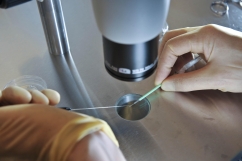
Under the rules introduced by Public Health Minister Jane Ellison, IVF clinics will legally be able to replace defective mitochondrial DNA from an egg with healthy DNA given by a donor. This process – known as "mitochondrial replacement therapy" – would reduce the number of children born with serious inherited diseases such as muscular dystrophy, but would also mean those children would technically have two mothers, or three parents in all.
Ellison said in a written statement: "The Government has run a comprehensive and transparent process over the lifetime of this Parliament to review the public acceptability of mitochondrial donation and the ongoing evidence of safety and efficacy of the new techniques involved.
"The time is now right to give Parliament the opportunity to consider and vote on these regulations."
Chief Medical Officer Dame Sally Davies has said that if approved, the process will "keep the UK at the forefront of scientific development," but critics have denounced it as a form of genetic modification. The Government, however, has been keen to emphasise that no nuclear DNA, which provides physical and other traits that children inherit from their parents, would be contributed from the donor.
According to CARE, however, the process could have a devastating impact on sense of identity, particularly as the legislation stipulates that the donor parent would remain anonymous.
The charity notes that Secretary of State for Health, Jeremey Hunt, has commissioned three safety reports from the Human Fertilisation and Embryology Authority (HFEA), but that the Government has proceeded without conclusions from pre-clinical trials to be published.
"They have also ignored evidence from their own consultation which showed clear opposition to the proposals," a statement from CARE adds.
"On the only occasion one of the proposed techniques (pronuclear transfer) was attempted in humans in China, it resulted in an abortion, a miscarriage and a stillbirth," Leach has pointed out, adding that support for the proposal has "fallen away dramatically across the course of the year".
"The Government is endangering patient safety - mitochondrial DNA provides far more than cell energy and actually informs the traits of resulting children making the term three parent children entirely appropriate," she concluded.
In August, the Church of England urged the Government to undertake more research before approving any plans, and called for children born from the process to have access to information about their donors.
"We believe that more research into the safety and efficacy of mitochondrial replacement therapy is necessary before regulations are introduced permitting the technique," a statement read.
"It is estimated that only around 10 children per year might benefit from current techniques while 1 in 200 children are born with some form of mitochondrial disorder. Further research, resulting in assured safety and efficacy is likely to be more beneficial in the long-term than premature application of uncertain techniques. The introduction of regulations ought to await the results of such research."
The legislation will be voted on by Parliament early in 2015, with the law to come into effect in October of the same year.