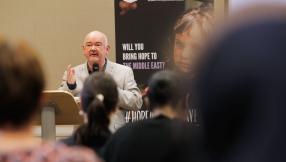
If day one of the Alliance for Responsible Citizenship (ARC) conference focused on the deconstruction of Western civilization, day two turned to the equally challenging question: what will it take to rebuild it?
For ARC, that task requires a “mindset shift” touching on everything from technology, energy and the economy, to the family, education and art. While speakers at the three-day conference have been wide-ranging and approached the question from different angles, a common thread has emerged: that Western civilisation cannot be renewed without recovering its Christian foundations.
Journalist and author Michael Shellenberger got to the heart of the problem: “The remarkable progress of science, technology and industry has weakened belief in the transcendent God and world order, without which people lack a way to make sense of inequality and suffering.”
Instead, many in the West have come to “blame civilization and structures of power for all inequality and suffering, and have placed their faith in an inversion of that order”.
The result is an "anti-civilization discourse” that is being driven by “unmet, spiritual and psychological needs” stemming from the decline in Christian faith and the traditional values that once undergirded Western civilization.
While efforts have been made to shore up the public's faith in Christianity and Christian values, these have “mostly failed” in his view.
“While there are some signs of a recent uptick in religiosity, the long-term trajectory is away from it,” he said.
“Anti-civilization activists have taken advantage of rising disbelief in a higher power to successfully sell utopian dream worlds.
"Because the vast majority of people in the West still favour civilization - and its pillars - the architects of civilizational deconstruction have created elaborate dream worlds that misdescribe reality and misattribute to civilization the harms that their policies create.”
The solution, he proposed, is “to make extremely clear the harms that anti-civilization policies cause, how they are linked together in a single de-civilising project, and why Western civilization remains the fairest and most humane form of social organisation ever created - one that has repeatedly earned, and most deserves, our faith”.
He went on: “It's difficult to maintain faith in your moral superiority when the victims of your policies are standing right in front of you.
“We must also reject their reality-denying language. It's child sterilisation and mutilation, not gender affirming care. It’s subsidising addiction and death, not harm reduction. It's racial preferences and discrimination, not diversity, equity, and inclusion.”
With modern life becoming ever more digital, conservative Catholic thinker Ross Douthat said the coming decades could witness a “mass extinction” of the many shared customs, institutions and “forms of cultural transmission” that have hitherto been taken for granted - things like marriage, a career and having children - unless a conscious effort is made to preserve them.
At the same time, Western societies are experiencing a “crisis of faith” not only in God, but in a sense of individual and collective purpose and the “basic goodness of Western civilization”, he said. In response, people are increasingly choosing “inferior” digital “substitutions” over real-life connections, contributing to rising levels of loneliness, “drift” and “despair”.
Douthat predicted that in the face of such rapid and far-reaching changes, only societies that have faith will survive - both the religious faith that believes humans have “a cosmic destiny”, and the optimist kind that says “human life is worth living”.
Jewish commentator Melanie Phillips said education was key to ensuring the successful transmission of shared culture and values from generation to generation. Instead, today's education has turned into destructive “de-education” based on a form of moral and cultural relativism that denies objective truth and presents Western civilization as “bad” and “evil”, she said. The route to reconstructing the “greatness” of British society and Western civilization is, therefore, to teach children to “love it”.
However, she echoed concerns raised elsewhere at the conference about a lack of understanding regarding the source of the West’s greatness. Many, she suggested, attribute it either to Ancient Greece or believe it to be universal to all mankind, when in fact it derives from “the Hebrew Bible mediated by Christianity - the superstructure of the West”.
“Judaism and Christianity provided not only the moral scaffolding of the West but enabled the West to become the powerhouse it became. Western science became Western science, and modernity became modernity, because they were built upon the Hebrew Bible mediated by Christianity,” she said.
“We have been taking a wrecking ball over many decades to the scaffolding of the West and we somehow expect the West to continue. It won’t. We have to reconstruct the scaffolding. It’s not hard; it’s there already. We just have to stop knocking it down.”
Former politician Ayaan Hirsi Ali spoke of a need to challenge today’s “feel good” culture and the “tyranny of feelings”, arguing that society must be willing to “make people uncomfortable” with the truth and work to restore a sense of God as “transcendent” and “Creator”.
Nigel Farage, whose Reform party has vowed to protect Britain's Christian heritage, touched briefly on faith when he spoke of his desire to restore the sort of strong community he grew up in.
"People looked out for each other. And the church and the shop and the pub - this is where everybody met. [When] I look back on that, it was a great way to live," he said.
He told the conference that addressing community and family breakdown was a priority for his party.
“I'm not pretending that government on its own can wave a magic wand, because it can't. But we can at least start to make the argument that living in a family and living with a genuine sense of community is a better way of life. And let's start to unashamedly [say] that,” he said.
Rod Dreher, author of The Benedict Option, suggested the West should recover a shared appreciation of the “sacred story” of how it came to be. He worries that AI and digital technology are only making this more difficult, and are accelerating a loss of human connection to the point where people are even trading human relationships for AI boyfriends and girlfriends.
“This is the voice of the devil symbolically and perhaps literally. It's saying that it's okay to prefer something we know is false to the messiness of reality [as long as it] makes us feel good. This attitude, I think, is pervasive in our culture today and as AI progresses, it's going to become perhaps the greatest temptation [for] all of us, whatever our religious faith,” he said.
Theologian and philosopher Dr Johannes Hartl said there was increasing openness among young people who are “getting more and more frustrated with those false promises”.
He cautioned, however, that “superficial religion and religiosity will not do”.
“We do need a conversion of our own hearts. Only this will make a difference,” he said.
He continued, “We have to take prayer seriously, and we have to be courageous to speak up.
“There is a generation thirsty to hear the truth, and thirsty for true spiritual awakening. The problem is most churches are no longer houses of prayer.
“There's only one moment where Jesus actually got angry. He said, my house shall be a house not just of politics and ethics and morals or education, but of prayer."
He added, "Encounter the living God. This is key.”
Dreher agreed that young people are “looking for meaning, for community, for purpose, for transcendence, and for God”, and that Christians must help them find the answers they are looking for:
“If we don't … we are going to lose them to the false and diabolical myths of racism, antisemitism, and the far right or far left - and it's coming. It happened in Weimar and it's going to happen to us if we don't wake up. We still have time, but we can't just sit back and observe. We have to act.”
ARC is not a Christian organisation but an international consortium for conservatives. Nonetheless, many of the speakers at this year's conference are Christians, as are many of the delegates.
American evangelical commentator Eric Metaxas, who was due to address the conference on Thursday morning, said he was "very encouraged" by the interest being shown in the perspectives of Christians.
He said it was "a healthy sign that people are recognising that without conversations about virtue, morality and faith, you can't have serious conversations about liberty or what it means to be conservative or traditional, because faith and God are inescapably at the heart of those things".