Have you ever been on one of those 'all inclusive' holidays? The kind where everything, from the beer at the bar to the food in the restaurant and the sauna in the swimming pool is included in the price. I have never managed that particular luxury but it strikes me that I really do want an all-inclusive church. One where everything is provided that is essential for spiritual birth, growth and renewal, and one where everyone is included.
It is often the boast of those who would style themselves as 'liberal, open and progressive' that they are 'inclusive.' They preach about wanting a more 'inclusive' church, often to their mono-cultural white liberal middle class congregation. But on this particular issue I have to say that I agree with the liberals. I want a more inclusive diverse church. But how can that happen? Just talking about it, or giving yourself the self-description, does not make it happen.
The trouble is that the imposition of politically correct ideologies under the guise of 'inclusive' Christianity is not real inclusivity. It only includes those who agree with the ideology in the first place. Real inclusivity is not based on PLUS (people like us). It is not based on race, social class, gender, age or political ideology. It is not based on religion. For there to be real inclusivity it has to be based upon such a foundation that it breaks down the 'dividing walls of partition'.
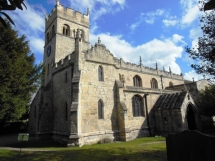
How is it possible? The answer is not that difficult. We preach Christ and his Word. Last week in my church St Peters, Dundee, I was amazed at the variety of people we had with us – an Indian family, Hungarian missionaries, a Nigerian family, another family from Chicago, people from Montrose, Dundonians, Irish students, Malaysian medics, people ranging from two weeks to 86 years old, rich and poor, those from a variety of religious backgrounds (Catholic, Presbyterian, Baptist, Charismatic, Pagan, Atheist and others); those with different political persuasions from Scottish Nationalist, Old Labour, New Labour, True Blue Tories, UKIP and Liberal-Democrats).
We were visited by a journalist, Kevin McKenna who wrote an astonishing article in The Scottish Daily Mail the following Saturday in which he declared, "What happened for two hours after 11am in Dundee last week was quite breath-taking. There was no waving of hands or hallelujah fervour or stamping of feet, just a joyful gathering of many people – from every background imaginable in modern polyglot Scotland; young and old; rich and poor; non-conformist and High Church."
What could bring such a diverse group of people together? What could keep them united in their diversity? Only Christ. Ironically those who say they want diversity and inclusivity, never get it when they exclude the source of that diversity and inclusivity – Christ. Changing Christ and his teaching in order to try and win people only ends up with more disunity.
Paul tells the Ephesian church that they were not always united. In Ephesians 2 he declares that we used to be dead in our transgressions and sins, separate from Christ, excluded from citizenship in Israel, foreigners to the covenants of promise, without hope and without God in the world (Ephesians 2). But... we were brought near - the apostle ends the chapter magnificently - "Consequently, you are no longer foreigners and aliens, but fellow-citizens with God's people and members of God's household,<sup> built on the foundation of the apostles and prophets, with Christ Jesus himself as the chief cornerstone.<sup> In him the whole building is joined together and rises to become a holy temple in the Lord. And in him you too are being built together to become a dwelling in which God lives by his Spirit." (Ephesians 2:19-22, NIV).
You don't get unity with Muslims by reading from the Quran. You get unity by bringing them Christ. You don't get unity with any group by giving them what they already have. You give them what they don't have – Christ. You don't get unity with those who don't share your skin colour, political or social views by trying to compromise. You have to go deeper.
You are not bringing them your views, you are bringing them Christ. And not just the vague wishy washy, 'your own personal Jesus is whatever you want him to be.' But the Jesus, who Paul tells the Ephesians, chooses, creates, and re-creates through his Spirit and because of his cross. Unity costs. To be 'in Christ' requires that we have been cleansed by the blood of Christ. It is the cross that brings peace, reconciles and gives us access to the Father by the one Spirit.
As a result we gather as his covenant community - not united by skin colour, social class or adherence to societal norms or political doctrines - but united simply as his people, cleansed by his blood, filled with his Spirit, secure in his promises and inviting 'whosoever will' to come to Christ. That invitation is far more likely to be accepted because they see the unity of the Trinity expressed in the Body of Christ.
The message of Christ leads to the unity of believers with the Trinity, that the world may believe! "My prayer is not for them alone. I pray also for those who will believe in me through their message, that all of them may be one, Father, just as you are in me and I am in you. May they also be in us so that the world may believe that you have sent me (John 17:20-21, NIV).
When you go on the all inclusive holiday you get everything thrown in. Its already paid for. When you get Christ, you also freely along with him, get everything thrown in. Its already paid for. Isn't real inclusive Christianity wonderful!