The writer of the Letter to the Hebrews reminds Christians that they are surrounded by a great “cloud of witnesses.” (NRSV) That “cloud” has continued to grow in size since then. In this monthly column we will be thinking about some of the people and events, over the past 2000 years, that have helped make up this “cloud.” People and events that have helped build the community of the Christian church as it exists today.
The Acts of the Apostles tells the story of how the Good News of Jesus rapidly spread out from the Judean and Galilean heartlands of the faith within a generation. However, we can sometimes forget about the apostolic missionaries whose travels and preaching are not recorded in the New Testament, for these too made a huge impact on the geographical spread of Christian faith.
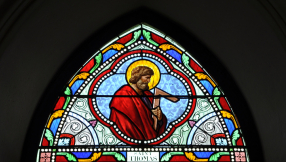
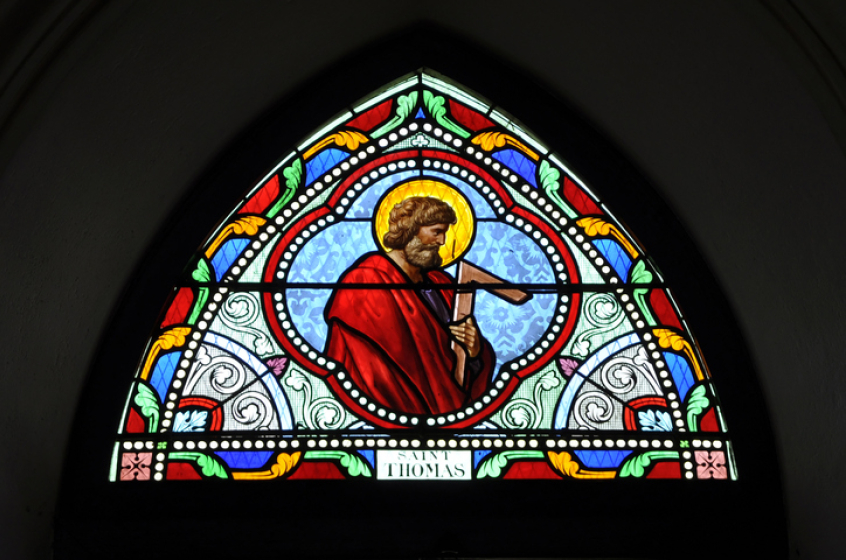
Of all the apostles, Thomas is perhaps the one whose reputation has travelled furthest from the New Testament heartlands and, indeed, from the Greco-Roman Mediterranean generally. In the Christian traditions of the East, he is remembered as the great missionary of the Persian and Indian worlds; a founder of ancient Christian communities; a martyr, and a leader whose legacy has shaped communities for nearly two thousand years.
The historical Thomas is elusive. The New Testament tells us little about his life, and says nothing about where he went after the Resurrection. As a result, the rich stories of his missionary career belong to a later body of literature and oral tradition and there are certainly questions about some of these as evidence. However, it would be going too far to classify all those traditions as mere inventions.
A number contain details that fit what is known about the ancient world of the East which suggests they may refer to real events. Others preserve memories cherished by early Christian communities which may contain ancient traditions. The challenge for us is to distinguish what can reasonably be reconstructed from the later traditions and, at times, the world of Christian legend.
Thomas in the gospels
Thomas appears in all four Gospels as one of the Twelve. His name is particularly prominent in John’s Gospel, where he emerges as a distinct personality rather than simply a name in an apostolic list.
John tells us that Thomas was also called “the Twin” (Greek Didymus). When Jesus announces his intention to travel to Jerusalem it is Thomas who responds courageously: “Let us also go, that we may die with him” (John 11:16). Consequently, Thomas is not simply the hesitant “doubter” of later popular imagination.
Thomas also appears again during Jesus’ farewell discourse, when Jesus tells his disciples that they know the way to the place where he is going and Thomas comments that they do not know where he is going, and asks how they can know the way (John 14:4-7). This results in one of the most famous sayings in the gospel when Jesus replies: “I am the way, and the truth, and the life” (John 14:6).
However, Thomas’ defining episode, however, comes after the Resurrection. Absent when the risen Jesus first appears to the other disciples, Thomas refuses to accept their testimony without physical evidence. Then when Jesus appears again - and Thomas is present - Jesus invites him to inspect the wounds. Then Thomas makes the dramatic confession: “My Lord and my God!” (John 20:28) Jesus responds with the blessing of those who have not seen and yet believe.
After this, the New Testament tells us little more about him. Thomas appears among the apostles in Acts 1:13, but Acts does not record his subsequent travels or death. A later source – the Gospel of Thomas, discovered near Nag Hammadi, Egypt, in 1945 - dates from the second or, perhaps, third century and contains sayings (“hidden words”) attributed to Jesus, revealed to Thomas, and showing Gnostic influences. Other - also later sources - claim to chart his career after the Resurrection.
Consequently, anything we know of his missionary career comes from sources outside the New Testament. These, though, tell us of extraordinary journeys.
Take 1. The missionary travels of Thomas - as far Parthia?
The earliest (extra-biblical) traditions do not agree. One important tradition connects Thomas with Parthia. This was a great Iranian empire stretching across parts of modern Iran, Iraq and into Central Asia. The third-century Christian writer Origen - whose testimony is preserved in Eusebius of Caesarea’s Ecclesiastical History (published in 324-325) - states that Parthia was Thomas’ missionary field. According to Origen: “Parthia ... was allotted to Thomas as his field of labour.”
This is much earlier than the Indian traditions which link Thomas with Kerala. This does not mean that we should dismiss these, rather it gives primacy of place to Parthia in terms of the date of recording of the supporting literature.
Another important early source is Clement of Alexandria (died c. 215), who preserves the tradition of an earlier (Gnostic) writer named Heracleon (active c. 175). This states that Thomas died a natural death and conflicts with the later - and much more famous - account of Thomas’ martyrdom in India. This is a reminder that early Christians did not possess a single (and universally agreed) biography of the apostle. But the traditions point East, away from the Mediterranean world that we know well from the Acts of the Apostles.
Take 2. The missionary travels of Thomas - as far as India?
The most elaborate account of Thomas’ later life is found in the Acts of Thomas. This is an early Syriac Christian work and is generally dated to the third century. It now survives in both Syriac and Greek versions. As a genre it might be described as a ‘religious adventure-romance.’
In the Acts of Thomas, Thomas is chosen by God to evangelise “India”. This term was used to describe areas to the east of the Parthian world and could extend to the River Indus (even if not necessarily into southern India), so it may be comparable to the Parthian tradition, just outlined. It may also have influenced the later Keralan traditions (see below).
Thomas is reluctant to go, so Jesus appears to him and sends him eastward in the company of a merchant named Abbanes (or Habban), who has received Thomas as a slave from Jesus. Thomas then arrives in the territory of a king called Gondophares. Having presented himself as a craftsman, the king gives him money to construct a palace. However, Thomas distributes the money to the poor and tells the king that he is building a heavenly palace. The king is angry at this, but a miraculous experience leads him to grasp Thomas’ meaning and, so, the king embraces Christianity.
The story is plainly influenced by the theology of the emerging asceticism of the third century onwards. Marriage is frequently rejected in favour of sexual renunciation, and the apostle’s ministry is portrayed as a struggle between Christian holiness and worldly power and lifestyle. Thomas performs miracles, challenges elites, converts households and (indicative of its time of compilation) preaches an uncompromisingly ascetic form of Christianity.
So far, so legendary. But there is some supporting evidence. Surviving coins and inscriptions reveal the existence of an Indo-Parthian ruler named Gondophares in the mid first century. He ruled a kingdom covering parts of modern-day Pakistan, Afghanistan, and northwest India. His coins bear his name in Greek letters and Kharosthi script. Now, this does not prove that Thomas met him as described in the text, but it indicates that the compiler had access to genuine information when it came to choosing the location, at least, of Thomas’ exploits. Consequently, it might preserve fragments of a historical memory within a largely fictional account.
Take 3. The missionary travels of Thomas - Edessa?
Thomas also became associated with Edessa. This was a major city in northern Mesopotamia (now Şanlıurfa in Turkey). According to an early tradition, a king named Abgar wrote to Jesus asking him to come and heal him. In reply, Jesus promises to send a disciple instead. In a version of this tradition, preserved by Eusebius, that disciple is named as Thaddaeus. However, the later Doctrine of Addai (late fourth or early fifth century) claims that the apostle Thomas sent another Christian, named Addai, to Edessa. His preaching converted the king and established a Christian community there.
This adds yet another facet to the traditions around Thomas and reveals how the connection with the East was picked up by later Christian communities there. In this case, Thomas replaced the less famous Thaddaeus. The tradition was clearly malleable!
What is clear is that Edessa became one of the great centres of Syriac Christianity, and Thomas became enmeshed in its (claimed) early sacred history. This was consistent with many Christian communities who sought a connection with first-century apostles. This was underscored by a sixth-century document called the Chronicle of Edessa, which records the transfer of Thomas’ relics to a church in Edessa dedicated to him, in the year 394. It also records the making of a silver reliquary for his bones c.441. Clearly, by the late fourth century a cult of Thomas existed in Edessa.
Take 4. The missionary travels of Thomas - the later Keralan connection
Today, the best-known tradition regarding Thomas is that he travelled to southern India, founding Christian communities there. Here, the so-called ‘Saint Thomas Christians’ of Kerala, on India’s tropical Malabar Coast preserve a tradition that Thomas arrived there in the year 52. Preaching among both Jewish and indigenous communities, he established seven churches. He later travelled eastwards, where he was martyred at Mylapore, near present-day Chennai (capital city of Tamil Nadu, located on the Coromandel Coast of the Bay of Bengal). Given Roman trade connections with southern India, this is all possible.
The tradition is strongly held but does not have an early literary base. Nevertheless, though late in its present written form, it preserves earlier church foundation-histories, songs and ritual performances. One, the Ramban Pattu (Song of Thomas), tells of the apostle’s arrival with the merchant Habban (as in the Acts of Thomas) and his missionary work. Passed down orally for centuries by the Christian Nasrani (Nazarene) community, it was formally written down in the late sixteenth or early seventeenth century.
Similarly, the Margam Kali Pattu (The Song of the Way) is an ancient ritual folk song and circle dance that dates, in its present form, to the seventeenth century. The Veeradiyan Pattu (Bard’s Song) is another traditional Malayalam (a Dravidian language closely related to Tamil) folk song. Once again, the surviving text can only be definitively traced back to the seventeenth century. Both claim to preserve stories of Thomas’ Indian ministry. These traditions are a powerful part of the living cultural inheritance of Kerala’s Christians.
There is also a long-standing tradition of Thomas’ tomb being located at Mylapore. By the Middle Ages the shrine there was sufficiently famous to attract pilgrims. However, the existence of an ancient Christian shrine does not, of itself, prove that Thomas was buried there.
As with the community at Edessa, these traditions connect South Indian Christians with the first generation of believers, rather than with later colonial-era missionaries. These claims of ancient apostolic roots are very important to these communities, even if historians are cautious regarding accepting them as reliable.
Thomas and South India. How convincing is the evidence?
The Acts of Thomas is an imaginative work; the Kerala traditions are much later still in terms of evidence for their first recording. What is most thought-provoking is the way these traditions combine. The orientation is always to the East.
Eastern Christianity had ancient roots buttressed by strong later traditions - including in southern India - even if we struggle to find early literary evidence to substantiate later claims. There was certainly trade and travel connecting the Roman, Parthian and Indian worlds. So, what to make of this? Thomas’ link to Edessa is fairly late and has the hallmarks of legend. Thomas in Parthia is very convincing. Thomas in Kerala is a possibility, but the tradition is Early Modern in its current form and first-century roots (though possible) are much harder to prove.
What is clear is that medieval Indian Christians (from late antiquity onwards), maintained close relationships with the Church of the East and the ancient Christian communities of Mesopotamia (Parthia). One possible process for the development of the Thomas tradition is: early and convincing eastern missionary work in the Parthian world; picked up and embellished by the compiler of the Acts of Thomas and claims made there regarding the origins of Christian communities even further to the east; further embellished, but connected to Edessa, by the compiler of the Doctrine of Addai; Keralan Christian communities (founded early but by unknown missionaries) made a connection with the “India” tradition and claimed it as their origin story in oral accounts, not reaching written form until the Early Modern Period.
It is a reminder both of how far and fast the Christian message spread in the century after the earthly ministry of Jesus, assisted by existing trade routes, and also how much we do not know about the mechanics and personnel involved. Alternatively, perhaps Thomas did go beyond Parthia, to found communities and die as a martyr in southern India. It is a fascinating possibility, and we cannot rule it out. It is certainly integral to the cultural history of the Nasrani (Saint Thomas Christian) community of Kerala. Thomas was far travelled.
Martyn Whittock is an historian and a Licensed Lay Minister in the Church of England. His recent books, exploring how ‘deep stories’ influence later community identities, include: Trump and the Puritans (2020), American Vikings. How the Norse Sailed into the Lands and Imaginations of America (2023) and Vikings in the East. From Vladimir the Great to Vladimir Putin (2025). He explored the history of the spread of Christianity from its original heartlands in the co-written Christ: The First 2000 Years (2016).