Scientists see bigger chances of finding intelligent life outside Earth: Exoplanets' discovery changes outlook

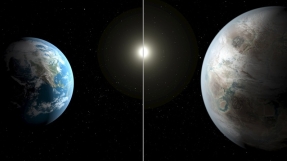
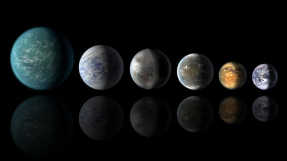
Artist's impression of habitable-zone planets with similarities to Earth: Kepler-22b, Kepler-69c, Kepler-452b, Kepler-62f and Kepler-186f. At right is Earth itself. (NASA)

Our chances of finding some other forms of intelligent life outside our own planet have grown bigger.

Scientists now think that there is a really low probability that the Earth is the only place in the entire universe which serves as a dwelling place of an advanced form of civilisation.

Astronomers changed their outlook on the possibility of finding alien life in space due to the recent discoveries of various exoplanets, or planets that are similar to Earth.

Space scientists also updated and revised the half-century-old Drake equation, a formula which attempts to calculate the probability of the existence of advanced alien civilisations, and of human beings communicating with them.

After revising the equation, astronomers realised that there is less than about one in 10 billion trillion chances that a human civilisation only evolved on Earth.

Adam Frank, research co-author and professor of physics and astronomy at the University of Rochester, said the Earth might not even be the first place where forms of intelligent life emerged.

"To me, this implies that other intelligent, technology-producing species very likely have evolved before us," he said in an article on CSMonitor.com.

Frank and his co-author, University of Washington astronomer Woodruff Sullivan, decided that it was time to take a second look at the Drake equation, because some gaps of knowledge not factored in the formula when it was first brought forward in 1961 have already been filled.

For instance, space scientists already currently know that about one-fifth of stars have planets in habitable zones through data obtained by the National Aeronautics and Space Administration (NASA)—a vital piece of information that was not factored in the original Drake equation.

"Our results imply that our evolution has not been unique and has probably happened many times before," Frank explained.

"The other cases are likely to include many energy-intensive civilisations dealing with their feedback onto their planets as their civilisations grow. That means we can begin exploring the problem using simulations to get a sense of what leads to long-lived civilisations and what doesn't," he added.

related articles
Extraterrestrial life more likely to be found in planets close to each other, says study

Extraterrestrial life more likely to be found in planets close to each other, says study

Hillary Clinton thinks aliens already visited Earth, wants investigation if she wins White House

Hillary Clinton thinks aliens already visited Earth, wants investigation if she wins White House

NASA\'s Kepler spacecraft spots 234 possible Earth-like planets in our own cosmic backyard
NASA's Kepler spacecraft spots 234 possible Earth-like planets in our own cosmic backyard

NASA's Kepler spacecraft spots 234 possible Earth-like planets in our own cosmic backyard

Astronomers able to locate fast radio bursts for the first time, but more mysteries remain unanswered

Astronomers able to locate fast radio bursts for the first time, but more mysteries remain unanswered

Only 41% of British \'Christians\' say they believe in a Creator while 18% say they do not, new survey shows
Only 41% of British 'Christians' say they believe in a Creator while 18% say they do not, new survey shows

Only 41% of British 'Christians' say they believe in a Creator while 18% say they do not, new survey shows

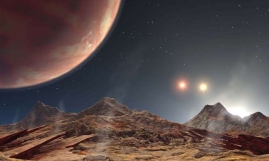
Astronomers spot alien planet with 3 suns, with 2 of them appearing as bright as full moons in the sky

Astronomers spot alien planet with 3 suns, with 2 of them appearing as bright as full moons in the sky

News
The first Christmas song to be sung in churches

Every Christmas, people sing the song “While Shepherds Watched Their Flocks by Night”. Unlike many other songs and carols that include elements of non-biblical tradition and myth, this song is pure Scripture. It was the first Christmas song authorised to be sung in the Church of England. This is the story …

The story of the Christmas Truce of 1914

On Christmas Eve in 1914, many men were in the trenches fighting the war, but the spirit of Christmas halted the conflict for a brief period. This is the story …

Report highlights injustices experienced by Christians in the Holy Land

Jerusalem Church leaders have released a report detailing the struggles and challenges currently faced be Christians living in the Holy Land.

Have you lost the wonder of Christmas?

For you who have been followers of Jesus Christ for a long time, maybe the pain and suffering of this world and the darkness you have had to live through this past year has gotten you down to the point of complete and utter discouragement. But all is not lost.