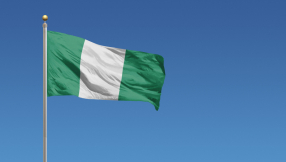
The BBC is reporting that suspected Islamist gunmen have attacked a college in north-eastern Nigeria, killing up to 50 students.
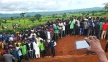
In this image taken with a mobile phone, rescue workers and family members gather to identify the bodies of students killed following an attack by Islamist extremist on an agricultural college in Gujba, Nigeria, on Sunday
The students were shot dead as they slept in their dormitory at the College of Agriculture in Yobe state. The college is in the rural Gujba district.
"North-eastern Nigeria is under a state of emergency amid an Islamist insurgency by the Boko Haram group," said the BBC story. "Boko Haram is fighting to overthrow Nigeria's government to create an Islamic state, and has launched a number of attacks on schools."
Classrooms burned
Casualty figures from the latest attack vary, but a local politician told the BBC that around 50 students had been killed.
The politician said two vanloads of bodies had been taken to a hospital in Yobe's state capital, Damaturu.
A witness quoted by Reuters news agency counted 40 bodies at the hospital, mostly those of young men believed to be students.
College provost Molima Idi Mato, speaking to Associated Press, also said the number of dead could be as high as 50, adding that security forces were still recovering the bodies and that about 1,000 students had fled the campus.
A Nigerian military source told AP that soldiers had collected 42 bodies.
The gunmen also set fire to classrooms, a military spokesman in Yobe state, Lazarus Eli, told Agence France-Presse.
In May, President Goodluck Jonathan, a Christian, ordered an operation against Boko Haram, and a state of emergency was declared for the north-east on 14 May.
"Many of the Islamist militants left their bases in the north-east and violence initially fell, but revenge attacks quickly followed," the BBC story continued. "In June, Boko Haram carried out two attacks on schools in the region.
"At least nine children were killed in a school on the outskirts of Maiduguri, while 13 students and teachers were killed in a school in Damaturu.
"In July in the village of Mamudo in Yobe state, Islamist militants attacked a school's dormitories with guns and explosives, killing at least 42 people, mostly students."
Boko Haram regards schools as a symbol of Western culture.
Boko Haram is led by Abubakar Shekau. The Nigerian military said in August that it might have killed him in a shoot-out.
However, a video released last week purportedly showed him alive. Other previous reports of his death later proved to be unfounded.
Boko Haram, which has particularly targeted Christians and churches, was founded in 2002. Its official Arabic name, "Jama'atu Ahlis Sunna Lidda'awati wal-Jihad," means "People Committed to the Propagation of the Prophet's Teachings and Jihad."
Nicknamed Boko Haram, a phrase in the local Hausa language meaning, "Western education is forbidden," launched military operations in 2009 to create an Islamic state across Nigeria, which is said to be 50 percent Christian and 50 percent Muslim.