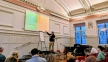
The growth of nationalism is raising important questions about how churches disciple the people in their pews, a panel of Christian leaders told the Church Resources Exhibition 2026.
The discussion was moderated by Andy Flannagan, executive director of Christians in Politics, with contributions from Dr Lisa Pal, head of racial justice in the Church of England Diocese of London, Dr Jonathan Chaplin, fellow of Wesley House, Cambridge, and Dr Nick Spencer, senior fellow of the Theos think tank.
Dr Spencer cautioned against using the term “Christian nationalism” so broadly that it encompasses even ordinary Christian involvement in politics, or love and concern for one’s country.
“It's worth saying that [Christian nationalism] does not mean being a Christian and having a sense of loyalty to your nation,” he clarified.
Dr Chaplin added that "not all nationalisms are necessarily evil", giving the example of civic nationalism in Scotland, but he said he feared that nationalism "so easily lapses into the bad kind".
Drawing on new Theos research, Dr Spencer noted that having a strong identification with Christianity did not necessarily translate into regular church attendance.
Among a group described in the research as “identity integrationists” - those who see Christianity as fundamental to Britishness and want to defend the country’s Christian heritage against perceived threats - 81% identified as Christian, but only 13% attended church weekly, compared with 11% across the entire study sample of 1,765 UK adults.
However, Spencer warned churches against concluding that nationalist views were to be found solely among people outside their congregations.
Another group, described as “belief integrationists” - those who want to promote Christianity and spread the Christian faith - was more likely to attend church and be more positive about welcoming asylum seekers. Yet it also included people expressing support for strongman leadership and, in some circumstances, political violence.
For Spencer, the findings highlighted how important it is that the Christian faith informs everyday conduct.
“I want people to call themselves Christian. I want them to come to church and believe Jesus is the Son of God, but I want that to filter through to how we live," he said.
"And within that, the process of discipleship and maturation as a Christian is going to become increasingly important."
Dr Pal similarly argued that Christian nationalism was more than a set of political opinions and that people must be willing to ask "critical questions" about their beliefs and what kind of person they are becoming.
“It is an ideology that is formational. And for us as Christians, we have to be really careful about what it is forming us into,” she said.
“I want to encourage us to interrogate what [our beliefs are] forming us into. What fruit does it bear, and how do we hold this up against the fruit of the Spirit?”
The discussion also addressed concerns that online personalities and political content are exercising a greater influence over some churchgoers than their local pastors and congregations.
Flannagan described hearing from church leaders whose congregations are so divided that people are now prepared to leave, whereas in the past they would have accommodated these differences of opinion. He described some churches as "struggling to win back their people from the online space".
Suggesting how the Church should respond, Dr Pal said Christians must invest in relationships and make room for difficult conversations.
“We cannot outsource discipleship to somebody else,” she said.
“We have to get back to walking alongside one another, knowing about one another's lives in order to have genuinely honest conversations.”
She added, "This is not a comfortable conversation for me, but I have to be brave enough to say I'm going to have the conversation."
Pal cautioned against dismissing the hardship underlying some people’s grievances, while acknowledging that churches have sometimes overlooked those in need.
Where people feel that schools, public services or wider society are failing them, she said Christians should seek to stand alongside them and work for change.
Spencer highlighted loneliness and the loss of local relationships as factors that could leave people more susceptible to problematic forms of nationalism.
“I do think one of the most important things is providing the space where people can just build relationships with one another. Simple as that,” he said, noting that this will matter even more as AI becomes increasingly embedded in everyday life.
Dr Chaplin argued that churches need to offer a "non-nationalistic, biblical patriotism" and biblical understanding of nationhood. He also challenged Christians to consider which biblical commitments their public engagement reflects.
“What is the Christianity that we want to defend?” he asked.