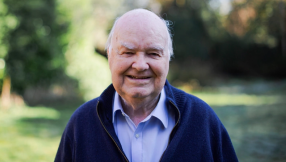
Churches need to devote more time and resources to evangelism and do more to equip their members to share their faith with non-Christians, evangelist Canon J John has said.
Speaking at the Church Resources Exhibition (CRE), the founder of the Philo Trust warned that many churches are devoting the overwhelming majority of their time and resources to worship and the wellbeing of existing congregations, while neglecting evangelism.
He recalled past research by the Philo Trust among 1,000 evangelical churches, in which only 36 said they had provided training in evangelism during the previous decade.
He challenged church leaders to be more intentional about evangelism, including making training in sharing the Christian faith a regular part of church life.
“Research indicates that we spend over 95 per cent of all of our time, energy, money, resources and manpower on worship and wellbeing. We spend less than 5 per cent on witness. Do you not agree there's a slight imbalance there?”
J John suggested churches distribute their resources more equally between the three. However, he argued that simply telling Christians to witness to others was not enough and that they needed to be shown how to do it.
“We've got to equip people. We've got to help people,” he said.
He encouraged churches to consider running an evangelism training course every year, saying they must think beyond the needs of their existing congregations and consider how they can reach people on the fringes of church life and those with no connection to Christianity.
“I want you to lead the church as if you were an evangelist,” he said.
“In other words, it's a mindset that you're not just thinking about the flock, but you're thinking about the fringe and you're thinking about beyond the fringe.”
The importance of intentional outreach and disciple-making was echoed by other speakers at the exhibition, who explored how churches could engage with younger generations and people who might never attend a traditional church service.
Phil Stokes, founder director of REACH, challenged churches to consider whether they were making disciples who could go on to make disciples themselves.
He described helping to establish a microchurch involving millennials who were seeking Christian community, with an emphasis on developing disciples who could establish similar groups elsewhere.
He shared how one couple involved in his microchurch had subsequently moved to Manchester and started their own one.
“So we haven't grown much, but we have multiplied,” he said.
Stokes also spoke of growing spiritual hunger among younger generations, saying he had seen millennials increasingly seek out opportunities to spend time with Christians over the past decade.
“We need a set of values that are attractive to the next generation. We need to be able to express and to live and to inhabit something which makes them say: we want that,” he said.
“And they do want it. The next generation wants something of what we've got.”
Bejoy Pal, CEO of the Ascension Trust, said churches needed to be willing to meet young people where they were.
Drawing on his experience as a street pastor in Croydon, he described talking with teenagers on the streets in the early hours of the morning because they felt they had nowhere else to go and nowhere else to take their questions.
“But Street Pastors isn't the only way to do it. We just need to ask ourselves: where are the spaces that these people are in? And then be intentional about going to those places,” he said.
Pal also stressed the importance of understanding the perspectives of younger generations, particularly when engaging with difficult issues.
“Young people feel that they need to be seen and heard,” he said.
“Where am I allowing myself to have expanded lenses to view the world in the way that young people view it? And do I understand their perspective - not necessarily to agree with it, but to be able to speak into what they are seeing.”
Although he cautioned against judging, he said it was acceptable to “bring challenge” to their views.
He added, “The most important thing is to pray for the individual, for them to be convicted by the Holy Spirit to see a fresh revelation of who God is that actually challenges any misconceptions that they may hold.”
The importance of building relationships rather than simply confronting people over their views was also highlighted by Andy Flannagan, director of Christians in Politics, who chaired the panel discussion.
He said that today’s online space was characterized by “too many armchair warriors, not enough relationship”, when in his experience personal conversations could be far more productive.
“It's very hard to challenge something online because people double down and get very defensive,” he said.
“Public shaming is not a good strategy, but it's amazing how many successes we get when we lift the phone and call somebody.”