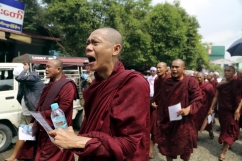
A powerful Buddhist ultranationalist group is helping Myanmar's ruling party win votes in next Sunday's election after the government pushed through laws seen as anti-Muslim, the co-founder of the group told Reuters.
Known by its Burmese initials Ma Ba Tha, the Buddhist nationalist group is not running a single candidate in the November 8 election – monks are barred by law from running for office. Yet it has been in the forefront of campaigning and could influence the shape of Myanmar's first popularly elected government in more than half a century.
For the first time, a Ma Ba Tha co-founder, a monk named Parmaukkha, disclosed some of the details about closed-door discussions between the group and the government on securing the passage of the bills.
The laws require citizens to seek government approval to convert to a different religion, force some women to have children at least three years apart and set punishments for having more than one spouse. An overwhelming majority of Myanmar citizens are Buddhist.
The new laws discriminate against Muslims and women and could stoke religious tensions, human rights groups say.
The ruling Union Solidarity and Development Party (USDP) used its parliamentary majority to push through the laws in the belief that "Ma Ba Tha would help them get votes in the election", said Parmaukkha, who helped found the group in 2013. "They know we are a strong organisation."
Tha Win, a USDP lawmaker and senior party official in Yangon, denied any connections with Ma Ba Tha. "We're just engaged in politics. Our party's rules don't allow us to carry out religious affairs."
Parmaukkha's description of Ma Ba Tha's role was also challenged by the group's spokesman, Thurain Soe, who said his organization was grateful for USDP's help in enacting the laws, but was not supporting any party.
"We needed our religious four bills. Who could we ask? We needed to ask this government. This is a very normal process," Thurain Soe said through a translator. "We thank the president and the parliament. But it's just 'thank you', not supporting [the USDP in the election]."
Reform referendum
The general election is the first since a quasi-civilian government replaced military rule in 2011 and is widely regarded as a referendum on Myanmar's reform process.
Ma Ba Tha's influence in Buddhist-majority Myanmar might prove crucial in the election campaign, especially in rural areas where monastic authority is unquestioned, election analysts said.
Its influence might sway enough votes from Aung San Suu Kyi's National League for Democracy (NLD) to deny the opposition party an all-important parliamentary majority, and save the USDP – created by the powerful military and chaired by President Thein – from an embarrassing electoral debacle.
Fearful of potential Ma Ba Tha intimidation, the NLD decided not to field any Muslim candidates on November 8, two senior NLD leaders told Reuters.
In recent years, religious violence in Myanmar has killed hundreds of people, mostly Muslims.
Formally known in English as the Committee for the Protection of Nationality and Religion, Ma Ba Tha grew out of the "969" movement, also led by monks, which called for a ban on interfaith marriages and a boycott of Muslim businesses.
Ma Ba Tha began cooperating closely with the government and the USDP in a series of meetings about the race and religion laws in 2014 and 2015, Parmaukkha said.
One meeting in the capital Naypyitaw in May 2014 was attended by officials from the ministries of religion, immigration and home affairs, as well as presidential advisers, he said.
Three other leading Ma Ba Tha monks confirmed to Reuters that they had attended the May meeting to discuss the bills with the government task force.
Members of the governmental team, including Soe Win, Myanmar's Minister of Religious Affairs, did not respond to requests for comments regarding the government's contacts with Ma Ba Tha.
The closed-door meeting has not been publicly disclosed before.
Gloomy party assessment
At another meeting in March 2015, a USDP official, who was also a director general in a government ministry, assured Ma Ba Tha the government would approve the race and religion laws, Parmaukkha said. Parmaukkha declined to identify the official and Reuters was unable to independently verify this account.
This was just weeks after an internal USDP survey, which Reuters reviewed, had suggested the NLD would trounce the ruling party at the polls.
Two months later, President Thein Sein signed the first of the four bills into law. The remaining three were enacted less than three weeks before the election campaign officially began.
Ma Ba Tha spokesman Thurain Soe denied leaders of his group had met government officials on the race and religion bills in 2014 and 2015.
Zaw Htay, a senior official from the President's Office, said it was a monk-led petition drive that gave the initial impetus to the laws. The campaign gathered more than 2 million signatures calling for enacting laws protecting race and religion and the President's Office drafted the laws in response to that petition, Zaw Htay said.
"It's very hard to separate Buddhist monks from politics in this country," he said, citing their role in Myanmar's struggle for independence from British colonial rule, as well as pro-democracy protests in more recent years.
Scorn for Suu Kyi
Ma Ba Tha's leadership has openly expressed support for the USDP and scorn for Suu Kyi.
Wirathu, 47, one of the most prominent of the Ma Ba Tha monks, endorsed President Thein Sein in an interview, saying his administration "opened doors and worked step-by-step for peace and development". He poured scorn on Suu Kyi and her party, saying: "NLD people are so full of themselves. They don't have a high chance of winning in elections."
Another monk who helped found Ma Ba Tha, Vimalabuddhi, said that since most of the USDP leaders are from the military they understood the situation in the country better than the NLD who were "politicians and civilians".
"They don't really understand our situation," he said.
Asked about these criticisms from Ma Ba Tha, senior NLD leader Win Htein told Reuters: "According to the teachings of Buddha, monks shouldn't get involved in political affairs. They should be neutral."
He said Ma Ba Tha has targeted the NLD from the start for not being supportive of their race and religion laws and being more sympathetic to Muslims. "That's why we decided not to field any Muslim candidates, for fear of antagonising Ma Ba Tha, losing votes and failing to win a parliamentary majority.
"It has caused some very hard soul-searching," he said.