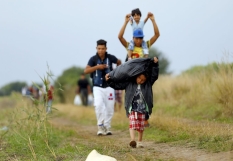
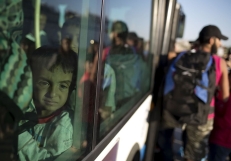
Trainloads of migrants arrived in Austria and Germany from Hungary on Monday as European Union asylum rules collapsed under the strain of a wave of migration unprecedented in the EU.
As thousands of men, women and children – many fleeing Syria's civil war – continued to arrive from the east, authorities let thousands of undocumented people travel on towards Germany, the favoured destination for many.
The influx is a crisis for the European Union, which has eliminated border controls between 26 "Schengen area" states but requires asylum seekers to apply in the first EU country they reach – something that is often ignored as migrants race from the fringes of the bloc to its more prosperous heart.
In line with EU rules, an Austrian police spokesman said only those who had not already requested asylum in Hungary would be allowed through – but the sheer pressure of numbers prevailed, and trains were allowed to move on.
"Thank God nobody asked for a passport...No police, no problem," said Khalil, 33, an English teacher from Kobani in Syria. His wife held their sick baby daughter, coughing and crying in her arms, at the Vienna station where police stood by as hundred of migrants raced to board trains for Germany.
Khalil said he had bought train tickets in Budapest for Hamburg, northern Germany, where he felt sure of a better welcome after traipsing across the Balkans and Hungary.
"Syrians call (Chancellor Angela) Merkel 'Mama Merkel'," he said, referring to the German leader's relatively compassionate response so far to the migrant crisis.
Late on Monday, a train from Vienna to Hamburg on which migrants were traveling was met in Passau, Germany, by police wearing bullet-proof vests, according to a Reuters witness.
Police entered the train and migrants were asked to accompany them to be registered. About 40 people were seen on the platform.
Police said they would be taken to a police station for registration.
Central challenge
Merkel, whose country expects some 800,000 migrants this year, said the crisis could destroy the Schengen open borders accord if other EU countries did not take a greater share.
"If we don't succeed in fairly distributing refugees then of course the Schengen question will be on the agenda for many," she told a news conference in Berlin. "We stand before a huge national challenge. That will be a central challenge not only for days or months but for a long period of time."
But it is far from certain her view will prevail when EU ministers hold a crisis meeting on September 14. Britain, which is outside the Schengen zone, says the border-free system is part of the problem, and a bloc of central European countries plans to oppose any binding quotas.
Refugees who managed to board the trains heading west on Monday mixed with well-heeled business travelers and tourists, some of whom were angry over the delays to their journey.
"I have a plane to catch from Vienna Airport. I took the train because of the road checks and the traffic jam...and now this? Are you kidding me?" said Orsolya Jakab, 35, a Hungarian accountant.
Outside Vienna station, thousands of supporters of the migrants chanted: "Refugees are welcome here".
"These people need help, they have come from a horrendous situation, we should not think twice about helping them," said Ottwin Schober, a retiree from Vienna who had been moved by the discovery of a truckload of 71 dead migrants in Austria last week.
"We escaped death"
Austrian authorities have stopped hundreds of refugees and arrested five traffickers along the highway from Hungary where the abandoned truck was found near the Hungarian border.
Interior Ministry official Konrad Kogler denied the clampdown, which includes increased checks on the eastern borders, violated the Schengen accord on free movement.
"These are not border controls," said Kogler. "It is about ensuring that people are safe, that they are not dying, on the one hand, and about traffic security, on the other."
At Munich, in southern Germany, police said around 400 migrants had arrived on a train from Hungary via Austria.
"There are advanced reports that at least one or two further trains ... are coming which could have a total of three, four or five hundred refugees on board," police official Juergen Vanselow, told Reuters TV.
At Munich station in southern Germany, two trains arrived from Hungary carrying several hundred mostly Syrian refugees.
Men, women and children smiled with relief on reaching German soil, and police shepherded them from the platform to a station outbuilding to be registered. They were then taken to waiting buses outside, to be transferred to a reception center in a former barracks in the north of the city.
Eighteen-year-old Syrian Mohammad al-Azaawi said he had abandoned his engineering degree and fled the country after being wounded by a car bomb. He showed reporters scars on his stomach.
His brother Ahmed said they had paid up to 3,000 euros ($3,365) to make their way via Turkey, Greece, Madedonia, Serbia, Hungary and Austria. The family had had to sell their house to raise the money.
"We escaped death in Syria. We want to stay here for a better future," he said.