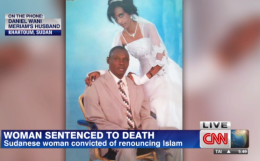
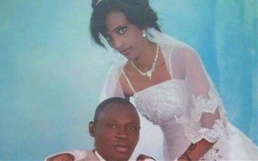
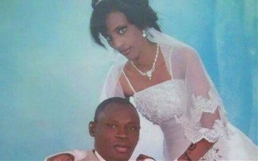
The case of Meriam Ibrahim, the pregnant Christian Sudanese women sentenced to death for 'apostasy' (leaving Islam), has sent shockwaves around the global community. But how common is this sort of case? Meriam Ibrahim was arrested on 17 February 2014, after Sudanese authorities found out she had married a Christian man. The court told Mrs Ibrahim she had until May 15 to convert to Islam, but she refused and the sentence was upheld. She remains imprisoned, along with her 20 month-old son, and her family reports she has not been allowed to receive visitors nor to access medical treatment. Her lawyers have filed an appeal which could take several months. So what is likely to happen? Will international intervention make a difference? And what does the wider religious and political landscape look like in Sudan? Here's an overview of the key facts and analysis surrounding the case which has gripped the world's attention.
Is there proof that Meriam Ibrahim has always been a Christian, does that matter?
Mrs Ibrahim was born in Western Sudan to a Sudanese Muslim father and an Ethiopian Orthodox mother. Her father left the family when she was six years old and she was subsequently brought up as a Christian by her mother. Although she is a life-long practising Christian, under Sudanese law Mrs Ibrahim is considered a Muslim because her father is a Muslim. Under Shari'a law in Sudan, Muslim women cannot marry non-Muslim men, so as she is considered to be a Muslim, her marriage is considered to be invalid. She is on a separate charge of adultery, in addition to apostasy.
Mrs Ibrahim testified in court on 4 March that she is a Christian, producing her marriage certificate, where she is classified as Christian, as proof of her religion. Three potential witnesses from western Sudan who went to the hearing to testify of Mrs Ibrahim's lifelong adherence to Christianity were prevented from giving evidence.
It should not matter whether Mrs Ibrahim has always been a Christian or whether she has left Islam to become a Christian – her right to freedom of religion or belief is protected under the interim Sudanese constitution, as well as under international conventions to which Sudan is party, that include the right to adopt a belief of one's choice. This is a non-derogable human right.
She's allowed to give birth – what will happen to the child and her toddler if she is put to death?
It is difficult to predict. The children will be seen as Muslim because their mother is considered to be Muslim, therefore it is unlikely that the state would allow Muslim children to be raised by their non-Muslim father. The children would be treated as wards of the state, or could be placed with estranged Muslim relatives from her father's side of the family.
What does apostasy mean? How is it proven? Is it a common offence in Sudan?
Apostasy refers to the act of renouncing a religion. According to strict interpretations of Shari'a law, apostasy from Islam is an offence punishable by death. In Sudan, Shari'a law is one of the sources of law under the constitution. Furthermore, apostasy is codified as a criminal offence in article 126 of the country's Penal Code. This means that a person can be charged, convicted and sentenced in a court of law, as has happened to Meriam, for this religious offence.
What's the religious breakdown of Sudan? How free are its Christians? What is the religious landscape in Sudan and where are the tension points?
Over 97% of those living in Sudan are Muslim. Under the regime of President al Bashir, an Islamist, Christians and religious minorities have been consistently harassed. Both blasphemy and apostasy are illegal, with the latter carrying the ultimate penalty of death. Christians are prohibited from holding open air meetings, and violence against those identifying themselves as Christian is common.
The challenges faced by religious minorities have existed for decades; successive governments have been hostile to religious and ethnic minorities, particularly since the Shari'a declaration of 1983. Decades of discrimination and violence played a decisive role in causing the South (which contains large Christian, animist and non-Arab communities) to separate from the predominantly Muslim and Arabised North. President al-Bashir repeatedly stated that following southern independence, Sudan would become an Islamic state with a new Shari'a-based constitution, which is in the process of being drafted in an opaque and non-inclusive manner.
Since the 2011 secession of South Sudan, religious minorities have experienced even greater hardship, hostility, and isolation. In particular, since December 2012, Christian Solidarity Worldwide has noted an increase in detentions, interrogations and deportations of Christians, as well as the confiscation and destruction of churches and church properties.
Do lots of people get put to death for apostasy? Are there other cases like this in Sudan which the international community doesn't know about?
If the sentence is carried out, Mrs Ibrahim will become the first person to be executed for apostasy under the 1991 penal code, prompting concerns that the charge may then be used increasingly against anyone who converts from Islam.
There have been other cases where people have been charged with apostasy, which have not received international attention because often individuals recant their new faith before the sentence is confirmed.
What is the international community doing? And how influential are they likely to be?
A number of countries have spoken out strongly on Meriam's case, including the UK, Canada and the US. The UK government summoned the Sudanese Ambassador to the Foreign Office on the matter and the Office of the High Commissioner for Human Rights has also spoken out, reminding Sudan of its obligations under international law. The more the international concern, especially from African and Middle Eastern countries and key Sudanese allies, the greater the likelihood that condemnation will make a difference. The Sudanese government has already been forced to issue a statement on Meriam's case, which means they are paying attention to the growing chorus of criticism.
You can add your voice by writing to the Sudanese embassy.
With thanks to Christian Solidarity Worldwide for providing the information in this article.