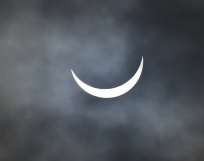
Like millions of others, I gathered with my family to watch the partial eclipse of the sun. Our house is on a hill, and the view from our bedroom window looks down over the valley of the River Trent so it offers a good vantage point. I had the bright idea of turning the whole room into a pinhole camera by making a hole in our blackout blind, and it worked a treat. My two children who were at home and I alternately watched out the window as the view became gloomier, and looked at the image of the sun in the room as it was eaten away by the shadow of the moon. (I still haven't confessed to my wife about the hole in the blind).
In some ways the eclipse was not very dramatic—certainly less so than, say, the black clouds casting darkness in a winter storm. Yet it was very memorable and quite eerie. There was a strange quality to the light; when I walked around our garden, the shadows seemed unusual, though not in a way you could ever capture on camera. It was as if the evening twilight had come, but at the wrong time and from the wrong direction. Birdsong seemed to be stilled, and there was a distinct chill in the air. You could see why the ancient Chinese would bang on pots and drums to frighten away the dragon that was eating the sun; if you stopped and looking, for a moment it was as if the life was draining away from the cosmos.
And yet, for many, life went on. I think the thing that most surprised me was that it did not get any darker than it did. That is, in part, because our eyes adjust to changes in light levels as they happen. But even with 90 per cent of the sun's light obscured, it was perfectly possible to see around and continue with life. The sun is very bright indeed, and it would take something of great enormity to obscure its light, even for a brief moment.
As we were watching, my mind turned to the Gospel accounts of Jesus' crucifixion. All three synoptic Gospels (Matthew, Mark and Luke) report that there was 'darkness at noon over the whole land' for three hours. This of course could not have been an eclipse; Passover happens at full moon, when the moon is opposite the sun from the earth's point of view, and eclipses must happen at new moon, when sun and moon are close. Besides, an eclipse could never last so long. John's Gospel does not record this, but perhaps he does not have to. For John, the light of the world has come to his own, and his own have not received him, but have rejected him and tried to extinguish the light.
Sceptical commentators suggest that the account of darkness this was an embellishment that was added to the Gospel accounts to make Jesus seem like an important figure comparable to other great leaders. But there is no need to suggest that; there are plenty of plausible explanations for the darkness caused by natural phenomena. Besides, all through the Gospels, the natural world functions as a window onto spiritual reality—the heavenly can be seen in the earthly, at least for those with eyes to see it. Nicodemus comes to visit Jesus in the dim twilight of incomprehension, whilst the woman at the well stands in the bright sunlight before the one who told her everything she had ever done. And when Judas goes out to betray Jesus 'it was night'—the darkest night of human history.
So perhaps the most interesting question about the eclipse is the personal one. Will events in the world around us make us stop and think? Where do we turn when the things that lit our world are suddenly dimmed or extinguished?
And Easter poses similar challenges. What is so great, and of such enormity, that it could snuff out the light of the world, the one that brought it into being in the first place? Will these questions make us stop, turn away from the busyness of life, and think? Or will we, like so many others, simply carry on with life as normal?
Rev Dr Ian Paul is associate minister at St Nic's, Nottingham, and Honorary Assistant Professor at the University of Nottingham. He blogs at www.psephizo.com and tweets at @Psephizo.