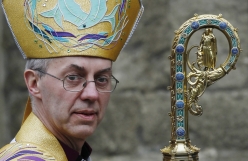
The Archbishop of Canterbury offered a defiant justification of last week's controversial bishops' pastoral letter 'Who is my neighbour?' at a conference in Coventry today.
The letter was criticised for being too critical of the Coalition Government and drew calls for the Church to confine its comments to spiritual matters.
However, speaking at the Love Your Neighbour: Think, Pray, Vote event at Coventy Central Hall, organised by the Joint Public Issues Team of the Methodist and United Reformed Churches and Baptist Union of Great Britain, Most Rev Justin Welby said that it was impossible for the Church "get on with the family business of saving souls" while politicians dealt with public policy.
He said that was a "completely false distinction, adding: "It is impossible to love Jesus Christ and not to care about the welfare of people in every respect." Proclaiming the good news of Jesus and transforming society were "indistinguishable": They are literally the two sides of the same coin. You do one, you do the other."
However, Welby also warned of the danger of the Church being driven by a particular political agenda, saying that it needed to avoid being drawn into "miserablism" – "That sense that we are only really happy as Christians when things are really bad.
"There can be a sort of co-dependency culture, where the worst thing that could happen is that social issues get sorted out. Because then what do we do?"
So, he said, the Church should rejoice that unemployment had fallen and that many fewer households were workless and that more businesses were being started than ever before. He argued for the implementation of the Living Wage for economic reasons – that it would encourage spending and avoid deflation.
He also praised the Government for its commitment to spending 0.7 per cent of national income on overseas aid, for passing the Modern Slavery Bill and its work on preventing sexual violence in conflict zones.
"If we are going to talk about justice and involvement in politics, we can't go in saying simply because someone wears a certain badge on their lapel, that they are therefore bad. That is not what Jesus did. So let us celebrate what we should celebrate," he said. "If we believe that the household and the family are crucial then we celebrate measures that support that. We should support all efforts that increase stability and hope in the job market, and welcome good news."
He addressed the criticisms of 'Who is my neighbour?', saying: "The Bishops' letter this week did quite a lot of that. It did it quite clearly. Obviously that wasn't entirely popular with some people. Almost no one seemed to think it was very good, apart from the people that read it – which appears to be a minimal number."
He stressed the need for Christian involvement in politics, saying: "Our concern for the common good stems from us being created in the image of God, and the consequential commands Jesus gives us: that we are to love God, our neighbour, each other, our enemies."
While there had been an economic recovery during the last year or two, he said, there was "a huge gap between where the economy could be and where it is, because of what happened in 2008". He stressed that the situation was not the fault of one party: "I am saying that that is something that has happened because of the financial and economic structures that we have built for ourselves, particularly since the 1980s."
He called on Christians to "proclaim the vision that is transforming, yhat excites and motivates, that challenges the cynicism that is the next state after the miserablism and just before nihilism."
Quote Sojourners founder Jim Wallis, he said that Christians needed to "change the wind" of politics: "transform the debate, recast the discussion, alter the context in which political discussions are being made, and you will change the outcomes ... You will be surprised at how fast the politicians adjust to a change in the wind."
Welby said: "If we are simply amongst those groups that say that we want a consumer politics based on our own particular idea of what society should look like, we will be constantly disappointed when a virtuous politics based on solidarity and the common good fails to develop.
"We must have the confidence to ask the big questions about what kind of society we want to be a part of and how we achieve it."