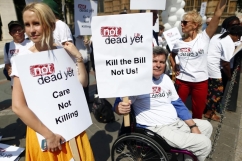
Judicial review challenges liberalisation of assisted suicide 'by the back door'

Assisted suicide is being liberalised "by the back door," disability campaigners warned as a court considers a relaxation in prosecution policy.

Two high court judges and the president of the Queen's Bench Division will today consider a judicial review on a change in guidelines for prosecuting cases of assisted suicide. The challenge is being brought by disability campaigners who say the change decreases the likelihood of healthcare professionals being prosecuted for assisting suicide.

"This may appear a subtle change but it is substantive and highly significant," said Nikki Kenward, who is paralysed and is bringing the case with her husband Merv.

"It makes it less likely that doctors and other healthcare workers would be prosecuted if they encourage or facilitate suicide and that places people at risk.

"Disabled people, the elderly, the terminally ill and others who are vulnerable need to be able to trust that doctors are there to protect life, not to assist death.

"This change undermines that. It is liberalisation by the back-door."

Encouraging or assisting suicide is a criminal offence under the Suicide Act 1961 and carries a penalty of up to 14 years' imprisonment. However in October 2014 the director of public prosecutions, Alison Saunders, amended the guidelines without consulting Parliament or the public.

The Kenwards argue the change means "ideologically motivated" doctors who assist suicides are more likely to escape responsibility.

Nikki Kenward was left paralysed by Guillain-Barré Syndrome for five months in 1990, only able to blink her right eye. Today she uses a wheelchair and says the change in wording "leaves vulnerable people at risk from dodgy doctors."

It is the first time a court has considered assisted suicide since Rob Marris MP's assisted suicide bill was firmly rejected by the House of Commons in September and it is unlikely to be the last, according to Andrea Williams.

"Assisted suicide campaigners repeatedly brought high profile cases to court to pressure Parliament to change the law," said Williams, chief executive of the Christian Legal Centre which is supporting the Kenwards.

"In September, the House of Commons gave very careful attention to the issue and voted against it by an overwhelming majority.

"Having lost the argument there, assisted suicide campaigners have signalled that they will refocus their attention on the courts," continued Williams.

"This relentless challenge must be resisted. The current law tempers justice with mercy and provides essential safeguards against abuse. We mustn't allow those safeguards to be undermined."


related articles
Assisted suicide: Dependence is part of being human

We are designed to share the weakness, vulnerability and dependence of the rest of the physical creation, says Prof John Wyatt.

Assisted dying is \'Pandora\'s box\' that will fundamentally change society - senior Tory MP
Assisted dying is 'Pandora's box' that will fundamentally change society - senior Tory MP

Assisted suicide is "understandable but wrong," Liam Fox, a senior Conservative MP, told Christian Today.

Five Reasons MPs Must Not Legalise Assisted Suicide

This is a milestone moment - here are five arguments against a change in the law.

Assisted dying devalues life, warns Archbishop of Canterbury

The Archbishop of Canterbury has warned that allowing terminally ill people to decide to end their lives would place unacceptable burdens on individuals and families and fundamentally change society's approach to the value of life.

MPs vote overwhelmingly against assisted dying

MPs voted overwhelmingly today to rejected the assisted suicide bill in one of the best attended debates on a Friday in recent months.

Abortion law devolved to Scotland as MPs pass Scotland Bill

Abortion law will be devolved to Scotland after MPs in the House of Commons voted through a series of new powers in the Scotland Bill.

News
Faith in difficult times: lessons from 1930s Britain

Architectural historian Steven Brindle talks to Christian Today about the faith that shaped 1930s Britain, the churches that supported struggling communities and what lessons the decade might have for us today.

Campaign aims to mobilise 500,000 Christians for Christmas outreach

Shine Your Light is aiming to mobilise half a million Christians to share the gospel with five million people across the UK this Christmas, with more than 2,000 churches already signed up, organisers say.

The Church of England should repent for previous calls to ban 'conversion therapy'

The Church of England's uneasiness about the government's ‘conversion practices’ bill is a perfect lesson in the old adage, 'be careful what you wish for,' writes Dr Martin Davie.

Leaked Home Office report links 'Christian extremism' to traditionalist beliefs and immigration concerns

An internal Home Office report lists concerns about immigration, multiculturalism and changing social values among the characteristics associated with what it calls "Christian extremism", it has been reported.