
Heralded as having the potential of starting a new industrial revolution and criticised as overstating the potential benefits arising from it, news that Dr Craig Venter and his team from Maryland, USA have successfully developed the first living cell to be controlled entirely by synthetic DNA has understandably caught the headlines of news bulletins around the world.
This emerging field of biology has been termed ‘synthetic biology’ but has also been referred to by the media as ‘extreme engineering’ and ‘biotechnology on steroids’. It represents a shift from merely seeking to understand biological systems to actually creating new ones.
Without doubt, Venter’s achievement is quite something but to label it as creating synthetic life is not entirely true. It is synthetic in so far as the DNA has been synthesised, but not that a new synthetic or artificial life form has been created. The relatively simple and primitive organism whose DNA was taken and modified already exists in nature.
Where to next?
Full blown artificial life has yet to be achieved, but it does not take that much imagination to see that based on the results of this breakthrough the creation of brand new organisms may not be that far around the corner.
Being able to scale up the process, thereby creating more complex organisms will be the next challenge in order to realise the fulfilment of eco-friendly biofuels (designer microbes which can feed off carbon dioxide and excrete biofuels), bio-medical interventions and computing technology. Whilst these developments may still be future aspirations and the potential benefits subject to much hype, the fact remains the intentions cause a nexus of ethical, legal and social implications to emerge which require serious thought and engagement.
Bioerror, bioterror and the ‘original syn’?
Alongside questions concerning bioerror (accidental release or escape of synthetic organisms into the environment) and bioterror (using synthetic biology as a bio-weapon), one of the prime concerns which has been expressed is that this groundbreaking development constitutes humans ‘playing god’ in terms of creating life.
At the heart of the Christian faith is the belief that humans were created ‘in the image of God’. Christians believe that every human being is made in the image of God. Humans reflect God’s image in what they do (capabilities and attributes) and what they are (their humanity). Therefore each human life has a unique dignity and unique value because of the divine image. If God is Creator God then one facet of the divine image humans bear is creativity. Yet that creative expression has limits to it. We cannot ‘improve’ upon human nature as this would involve altering the image which we bear.
Moreover, by its very nature synthetic biology treats biological organisms as nothing more than sophisticated machines, thereby causing life to be considered solely from a reductionist perspective, prevalent in contemporary science not least biology and specifically genetics. In brief, a reductionalist perspective seeks to take the complexity of any given system and understand it from the bottom up. The outcome is that a reductionalist methodology results in a reductionalist ontology; the system is explained wholly by the properties of its component parts. Therefore life is life, regardless of the means by which it has been created and whether or not one believes some special or divine force has been involved in its creation.
The significance of this latest advance therefore is not necessarily what it demonstrates here and now but where it points to in terms of the future and where it may take us. Should further developments occur in synthetic biology which allow us to modify natural life forms into something radically different, then this would pose serious ethical questions. How would we begin to value different forms of ‘life’? To what extent would the application of synthetic biology result in new manipulative possibilities for the human project in terms of the design and creation of life?
Matt James is a consultant and writer on bioethics and emerging technologies. He works for the UK thinktank, BioCentre, but wrote this article for The Jubilee Centre in a personal capacity. This article first appeared on The Jubilee Centre website: www.jubilee-centre.org/blog/305/itand039s_life_jim_but_not_as_we_know_it and is reprinted on Christian Today with permission.
-

Churches must do more to equip Christians for evangelism, says J John
-

John Lennox urges Christians to overcome fear of sharing their faith
-

US Episcopal Church membership falls below 1.5 million as decades-long decline continues
-

Young people are finding their way to the Christian faith through media, says bishop
News
-

Nicky Gumbel elected to Church of England parliament with a call to put evangelism first
-

Pastor died after wooden arch fell at Big Church Festival, inquest hears
-

John Lennox urges Christians to overcome fear of sharing their faith
-

Priest dies after cross falls on him during livestreamed Mass
-

Are we ready to battle for the Gospel?
-

Church warden and rector lead legal challenge against Church of England's Project Spire
Most Popular
News

Ebola death toll mounts as outbreak spreads further across DR Congo
Healthcare workers are struggling to contain the disease amid shortages of essential medical equipment and ongoing insecurity.

Research suggests married mothers are happier
New research has suggested that married mothers report significantly higher levels of happiness than those who are single or unmarried.
US Episcopal Church membership falls below 1.5 million as decades-long decline continues
The US Episcopal Church has reported a further decline in membership and worship attendance, with new data it has fallen below 1.5 million members despite signs of post-pandemic stabilisation.
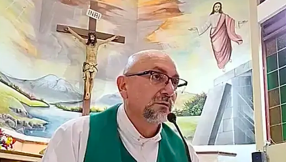
Priest dies after cross falls on him during livestreamed Mass
A priest in Guayaquil, Ecuador, has died after a crucifix fell on him during an evening Mass on Saturday.








