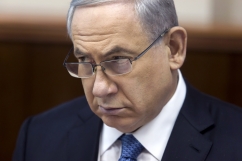
Israel's Prime Minister Benjamin Netanyahu delivered a speech to the US Congress yesterday in which he warned of the danger of doing a deal with Iran over the development of its nuclear capabilities. Republicans cheered him to the rafters, Democrats largely stayed away or sat with stern expressions and folded hands, and the White House was unimpressed. But what's going on under the surface, and why is it such an issue?
You'll have to explain why Obama was so frosty.
Several reasons. First, the invitation to Netanyahu was given by the Speaker of the House of Representatives, John Boehner, in a breach with protocol; these things should come through the White House. Second, though historically US support for Israel has been unquestioned and bi-partisan, Republicans – who include many evangelicals who would be associated with the Christian Zionist movement – think President Obama is wobbly on Israel and are making a political point by showing their enthusiastic support for its Prime Minister. Third, negotiations with Iran are at a delicate stage and the administration doesn't want complications. Fourth, Netanyahu is facing elections at home and his Congress appearance was a priceless campaign boost, and as such inappropriate. Fifth, Obama is deeply frustrated by Netanyahu's intransigence over the Palestine question. Sixth – well, it's a long list and we have to stop somewhere.
But isn't Netanyahu right to say that Iran shouldn't get nukes?
Indeed, and no one's saying that it should. However, Iran has always denied that it intends to make nuclear weapons, claiming that its development programme is for entirely peaceful purposes. The international community has been sceptical of these claims, not least because of its record of hostility toward the West in general and Israel in particular – which flared up again after the US supported Iraq in the Iran-Iraq war. While it officially rejects anti-Semitism, Holocaust denial is routine among Iran's political and religious leaders. It does not recognise Israel. It supports the anti-Israel Hezbollah movement in Lebanon and armed Hamas in Gaza. It backs Syria's President Assad. There is a long and melancholy history of assassinations and counter-assassinations. Iran has been the target of cyber-warfare aimed at slowing down the nuclear programme.
None of this sounds good.
It isn't, and this kind of thing makes Israel and America very sceptical of any talk of rapprochement. However, at various times Iran has tried to send signals that it wanted to reset relationships, for instance after 9/11 when it offered help against Afghanistan. Months later this promising beginning was scuppered when George W Bush described it as part of the famous "Axis of evil". In 2013, Iran's new President Hassan Rouhani held a phone call with President Obama – the first conversation between US and Iranian heads of state for 30 years.
Does Iran want to acquire nuclear weapons?
It depends on whom you believe. Netanyahu certainly thinks so. It is also certain that Iran has acquired the technical know-how to be able to do so. Whether it intends to produce a nuclear weapon and use it is a different question. The deal which Secretary of State John Kerry is trying to negotiate is aimed at putting into place a system of inspections, safeguards and verifiable guarantees to make sure that if it tries to do so it will be detected.
So what does Netanyahu have against that?
He thinks it won't work. Iran will become a nuclear-armed state and will threaten Israel, and a militant and fanatical form of Islam – which in his speech he equated with Islamic State – will get the bomb. Iran is admittedly very worried about Islamic State and is supporting attacks on Tikrit, but Netanyahu says that doesn't make it everyone's friend.
And his alternative?
Ah. The weakness of his position is that there really isn't one. He would like to see a regime change and an Iran that is better disposed to the rest of the world and Israel in particular. He is against the lifting of sanctions – which are what has brought Iran to the bargaining table – because he says that would make it even more rich and powerful and able to do more damage.
That is not unconvincing.
Indeed, though it is not really a long-term strategy and can only delay Iran's acquiring a nuclear capability if that's what it wants to do, rather than stop it altogether.
One of the problems is that Iran is not really a normal country. It is a theocracy whose aging mullahs have the final say on a whole range of policies. But it also has a very young population – 70 per cent of them are under 30 – many of whom are attracted to more Western lifestyles and are unimpressed by their highly traditionalist rulers. The prospect of a change to a less confrontational society better integrated into the international community is not wildly implausible – though it might take time. Meanwhile, sanctions are hurting.
It doesn't take long to build a nuclear weapon, though.
Not very long, certainly, but it can't be done overnight. Those negotiating with Iran have to calculate that they can make nuclear weapons so unattractive to it that it will see that its best interests lie elsewhere. It is about containing and managing risk rather than eliminating it entirely.
Alongside the diplomacy around nuclear weapons there is also engagement – usually under the radar – around other issues. However, it's always complicated by the fact that Iran, unlike most countries, has multiple power centres.
So, they're really the good guys?
Hardly, though they have been very badly treated both by Britain and America in the past – for instance, the CIA engineered the topping of the democratically-elected government and consolidated the dictatorship of the Shah in 1953. Internally, it is a repressive regime which is intolerant of opposition. Externally, it contributes to the instability of the region by sponsoring proxy armies.
So, they're really the bad guys?
It's not that simple, and problems have to be broken down into smaller pieces in order to solve them. Yes, Iran's sponsorship of Hezbollah is a problem. But stopping it getting a nuclear weapon is a bigger problem, and that is what the US is trying to do. The trouble is that seeing Iran as a perpetual enemy means that it becomes a perpetual enemy. Slow, patient diplomacy means doing deals and shaking hands with people you don't like. In the last analysis, the consequences of not keeping Iran on board are worse than the consequences of talking to them. Remember that North Korea has been completely isolated – and it has tested nuclear weapons.
It isn't necessary to see Iran as a model of enlightened liberal democracy in order to do business with it. The calculation has to be whether it is worth it.