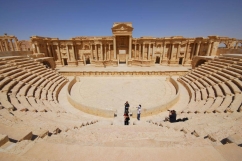
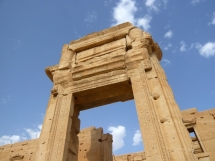
Syrian government forces drove Islamic State fighters out of Palmyra on Sunday, the army said, inflicting a major defeat on the militants who seized the desert city last year and dynamited its ancient temples.
The army general command said in a statement that it had restored security and stability to the city in an operation it said showed that Islamic State was beginning to retreat and collapse.
The Syrian Observatory for Human Rights said there were still clashes on the eastern edge of Palmyra, around the prison and inside the airport, but the bulk of the Islamic State force had withdrawn and retreated east, leaving Palmyra under President Bashar al-Assad's control.
Syrian state-run television broadcast from inside Palmyra on Sunday morning, showing largely deserted streets and several badly damaged buildings.
It quoted a military source saying Syrian and Russian jets were targeting Islamic State fighters as they fled, hitting dozens of vehicles on the roads leading east from the city.
For government forces, the recapture of Palmyra opens up much of Syria's eastern desert stretching to the Iraqi border to the south and the Islamic State heartland of Deir al-Zor and Raqqa to the east.
It follows a three-week campaign by the army and its allies on the ground, backed by intensive Russian air strikes, aimed at driving Islamic State back.
Russia's intervention in September turned the tide of Syria's five-year-old conflict in Assad's favour. Despite Moscow's announcement that it was pulling out most military forces two weeks ago, Russian jets and helicopters carried out dozens of strikes daily over Palmyra at the height of the clashes.
Biggest defeat
Observatory director Rami Abdulrahman said 400 Islamic State fighters died in the battle for Palmyra, which he described as the biggest single defeat for the group since it declared a caliphate in areas of Syria and Iraq under its control in 2014.
The loss of Palmyra comes three months after Islamic State fighters were driven out of the city of Ramadi in neighbouring Iraq, the first major victory for Iraq's army since it collapsed in the face of an assault by the militants in June 2014.
Islamic State has lost ground elsewhere, including the Iraqi city of Tikrit last year and the Syrian town of al-Shadadi in February. The United States said the fall of Shadadi was part of efforts to cut Islamic State's links between its two main power centres: the cities of Mosul in Iraq and Raqqa in Syria.
The Observatory said around 180 government soldiers and allied fighters were also killed in the campaign to retake Palmyra, which is home to some of the most extensive ruins of the Roman empire.
Islamic State militants dynamited several monuments last year, and Syrian television broadcast footage from inside Palmyra museum on Sunday showing toppled and damaged statues, as well as several smashed display cases.
Syria's antiquities chief said this week that other ancient landmarks were still standing and pledged to restore the damaged monuments.
"Palmyra has been liberated. This is the end of the destruction in Palmyra," Mamoun Abdelkarim told Reuters on Sunday. "How many times did we cry for Palmyra? How many times did we feel despair? But we did not lose hope."