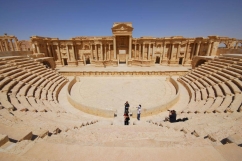
A 2,000-year-old arch from the ancient Syrian city of Palmyra is set to be replicated in London and New York as a "call to action" against Islamic State, which has overrun the city.
ISIS militants captured Palmyra from Syrian government forces in May, and have since destroyed a number of historic and religious sites in the city. The Temple of Bel was blown up by the jihadists in August, but its arch remains, and will be recreated by the Institute of Digital Archaeology (IDA) to be erected during World Heritage Week in April 2016.
The reconstruction will be done via 3D printers, using images taken by volunteer photographers. The two arches, to be made in China, will be placed in London's Trafalgar Square and New York's Times Square.
Executive director of the IDA, Roger Michel, said that the project is about restoring dignity to those systematically persecuted by Islamic State.
"It is really a political statement, a call to action, to draw attention to what is happening in Syria and Iraq and now Libya," he told the Times.
"We are saying to them 'if you destroy something we can rebuild it again'. The symbolic value of these sites is enormous. We are restoring dignity to people."
Director of technology, Alexy Karenowska, said the project aims to increase understanding of why the preservation of cultural sites is so vital.
"People say, 'should we be worrying about this stuff when human lives are being lost?'" she said.
"Of course all of this stuff takes second place to human life, but these cultural objects are very important to give a sense of place and community."
"We tend to think about cultural heritage in a somewhat parochial way," Karenowska added, according to the Guardian. "We also think of other people's cultural heritage as being something that's particular to them.
"We see that very much with the Middle East. People in the west find it very easy to say that the Middle East has this great cultural heritage and this problem [of its destruction] is something that's happening to them.
"The idea is to underline that cultural heritage is something that's shared between people. It's about people's roots and it's important to recognise also that this is something that as humans we do all understand on some deep level."
Palmyra was one of the most important cultural centres of the ancient world, according to cultural agency UNESCO, which has described it as the crossroads of several civilizations.
Islamic State has declared a caliphate in territory it holds across Syria and Iraq and has destroyed other monuments it says are pagan and sacrilegious.
UNESCO has called such acts war crimes and says Islamic State seeks to wipe out evidence of Syria's diverse heritage.
Before the capture of the city, Syrian officials said they had moved hundreds of ancient statues to safe locations.
Additional reporting by Reuters