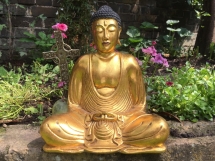
Last week's news that 40 dead tiger cubs were found frozen in the freezer of a Thai Buddhist Temple which was being investigated for sex trafficking is not exactly congruent with the peace-loving image of Buddhism we often encounter.
Buddhism is often perceived to be the least offensive religious option for the curious atheist to explore - a philosophy of religion focused on peace and personal growth. This news story throws a spanner in the works.
Is Buddhism the peaceful religion everyone thinks it is?
This is not the first manifestation of Buddhist violence, in fact the frozen tigers are just the latest in a long list of violent Buddhists.
In Thailand monastries have been used as military outposts and the government has commissioned special military monks. Similarly, in Myanmar there is a strong vein of Burmese Buddhist nationalism that has become increasingly intollerant of religious minorities.
However, when you get back to the actual teachings in Buddhism, it is pretty clear that at its heart is not violent. Buddha condemned killing or harming living things often.
That buddhism is a peaceful religion is true, but there are other areas where understanding is less founded on truth. Behind the veneer of yoga and meditation cherry-picked by Western culture is a Buddhism focused around concepts more challenging than you might expect.
Here are three examples of such misconceptions:
1. Enlightenment is blissful
Enlightenment is not about bliss, but about detachment.
The entire religion is based around the letting go of the self - the anatman. It teaches that a person no more than the five aggregates - or parts - put into a human body: Just like a car is made up of physical parts, a human is too.
One of the very first concepts that Buddhists learn is that "Life is Dukkha", which essentially means Life is Nothing. No bliss, no joy, just nothing.
They believe that we are not a being with a soul, but just a compilation of aggregate parts that make a person - that human life has no inherent value.
The aim of the Buddhist game is to realise that the self is not important and conclude that we are nothing.
This is a pretty stark constrast to Jesus' message, who teaches that all humans are made in the image of His Father and are of infinite value - enough for him to die for us, in fact. Our eternity is not in nothing-ness, but in eternal relationship with God in heaven.
2. Buddhism is the best religion for women
That Buddhism is a peace-loving religion might suggest there is a natural leap to say it is a woman-loving one. This is not the case.
Buddha is recorded as questioning whether women could be ordained - fearing that it would make his message less successful - and now that it is allowed, strict hierarchies are at play. Even the most senior nuns are considered lesser than monks who have been ordained for one day.
There are even schools of thought within Buddhism that question whether women are capable of being englightened. One school of thought says that for a woman to reach Nirvana they would have to be reborn as a man.
Now, obviously historically Christianity doesn't have a clean slate when it comes to treatment of women either. However, when you look at Jesus himself, his treatment of women is pretty radical - he keeps female company, listens to their testimonies and responds to their prayers. Christianity is inherently pro-women.
3. It's a philosophy of life, not a religion
A lot of atheists consider Buddhism to be more of a philosophy than a religion - it gets off lightly with religious critics compared to Christianity, for example.
While Buddhism may not resemble Christianity as a religion, with a personable God who is both our creator and personal saviour, it remains a religion.
The great majority of Buddhist practice has been focused on a good rebirth in the next lifetime and - although Buddhism doesn't speak of God in a Judeo-Christian sense - it does have an elaborate plethora of celestial beings who exist in various heavens and respond to the prayers of the devout.
Where Buddhism ultimately seeks detachment, Christianity ultimately seeks relationship - relationship with God and then with others.